
Train Toward Your ICF ACC Credential

The Performance Coach Level 1 is an ICF-accredited coach-training programme that builds real coaching confidence through hands-on practice, mentor support, and a clear pathway to your ACC credential—typically completed in 6–8 months.

3D illustration of an online coaching session with DISCO LMS and ConveraLab for TPC Level 1
icfLevel 1 Accredited Coach
Training Programme
60+ hoursCoach education
10+ hoursMentor coaching
5 sessionsObserved coaching practice
6–8 monthsTraining duration

Knowing coaching is not the same as being able to coach.

The Performance Coach (TPC) Level 1 goes beyond coaching theory. This ICF-accredited coach training programme helps you develop practical coaching skills through real practice, feedback and reflection, so you can coach with greater confidence in real conversations.

Explore how you’ll learn

Aspiring Professional Coaches

You want to build practical coaching skills and work towards your ICF ACC credential.

Leaders & Managers

You want to use coaching skills to lead better conversations, develop people and strengthen your leadership.

HR & L&D Professionals

You want practical, ICF-aligned coaching skills you can apply to people and leadership development in your organisation.

Professionals Exploring Coaching

You’re considering coaching as a new career, an additional professional skill, or the next step in your development.

Coaching Skills You’ll Develop in TPC Level 1

By the end of the programme, you’ll be able to:

Lead a Complete Coaching Conversation

Structure a coaching conversation from opening to meaningful action.

Build Trust & Psychological Safety

Create the conditions for open, honest coaching conversations.

Listen Beyond the Words

Notice what’s said, unsaid and emerging in the conversation.

Ask Questions That Deepen Awareness

Use thoughtful questions to help people reflect and discover new perspectives.

Coach Real-World Situations

Apply your coaching skills with confidence across different conversations and challenges.

Coach in Line with ICF Core Competencies

Develop your coaching practice around ICF standards.

Hear from our graduates

Your path to ICF ACC

Your pathway to the ICF ACC Credential: complete TPC Level 1, build your coaching experience, then apply to ICF for your ACC credential.

1

Complete ICF Level 1 Coach Training

Complete TPC Level 1 with 60+ coach education hours, 10 mentor coaching hours and a performance evaluation.

2

Complete 100 Hours of Coaching Experience

Build 100 hours of coaching experience through real client coaching and continued practice.

3

Apply & Pass the 60 Question ICF ACC Exam

Submit your ICF ACC application and complete the 60-question ACC Exam as part of the credentialing process.

4

Earn the ICF ACC Credential

Once all ICF ACC requirements are met, you can earn the Associate Certified Coach (ACC) credential.

Explore how you’ll learn

Note: The ACC credential is awarded by the International Coaching Federation (ICF). Completing TPC Level 1 supports the education and mentor coaching requirements but does not itself award the ACC credential.

How you’ll learn

Coaching is learned through practice.

Our experience is a continuous cycle of learning, practice, feedback, reflection and real-world application.

LearnLive interactive sessions
PractisePeer coaching and ConveraLab scenarios
Be observedFive observed coaching sessions
Receive feedbackMentor coaching and supervision
ReflectJournaling and self-awareness
ApplyReal conversations in real situations

What makes TPC Level 1 different?

More than a certification. A real coaching experience.

Practice is built into the programme

Live practice, observed sessions, feedback and reflection are part of the learning journey—not optional extras.

You don’t practise alone

Mentor coaching, supervision, peer coaching and The Coaching Village provide ongoing support.

Grounded in human performance

Insights from performance psychology, leadership and high-performance environments deepen your practice.

Practice beyond the classroom

ConveraLab offers more realistic coaching practice and personalised feedback between live sessions.

Programme brochure

Want the full programme details?

The brochure-download form will be connected here after its final fields and delivery method are confirmed.

Speak to an advisor in the meantime

Programme modules

What you’ll explore along the way.

01 — Introduction to coaching

Discover what makes coaching different from giving advice and build your foundation in coaching ethics and ICF competencies.

02 — Principles of human performance

Explore the behavioural and performance foundations that inform meaningful coaching conversations.

03 — Unlocking effective agreements & contracting

Learn how to establish clarity, focus and shared responsibility in coaching relationships.

Live online cohorts

Find a cohort that fits your schedule.

Choose the language and dates that work for you. Sessions are delivered live online, with flexible support if you miss a class.

What’s included

60+ education hours
10 mentor coaching hours
5 observed coaching sessions
Performance evaluation
Group supervision
Peer practice
ConveraLab access
Lifetime Coaching Village access

Cohort dates, fees and delivery language will be confirmed before publishing.

Frequently asked questions

Questions people ask before joining.

What is The Performance Coach Level 1?

It is an ICF-accredited coach-training programme designed to develop practical coaching skills through live learning, practice, feedback and mentor coaching.

Does completing TPC Level 1 make me an ICF ACC coach?

No. It supports the education and mentor-coaching elements of the pathway; ICF awards ACC only after all its requirements are met.

Is this suitable for leaders and HR professionals?

Yes. The programme is designed for people who want to use coaching to develop others and lead more effective conversations.

Do I need coaching experience before joining?

No prior formal coaching experience is required. The learning experience builds from core foundations into supervised practice.

How much real coaching practice will I get?

You will practise through live learning, peer coaching, observed sessions and realistic conversations supported by feedback.

About TPC Level 1

Build practical coaching skills that travel into real work.

The Performance Coach Level 1 by Emerge Performance is designed for leaders, HR professionals and developing coaches who want to strengthen how they listen, question, develop people and support performance.

HomeAll InsightsBlogLearn to Be a Better Leader by Avoiding these Biases

Learn to Be a Better Leader by Avoiding these Biases

Leadership training becomes more valuable as the organisation, team and environment change. The habits that helped someone succeed as an individual contributor may not be enough to lead through uncertainty, develop people or make decisions with incomplete information. Better leadership begins with staying curious long enough to learn what you may not yet see.

One barrier is cognitive bias. Bias does not mean a leader is careless or incapable; it describes the shortcuts the mind uses to interpret information. When those shortcuts go unchecked, they can make the old way of working feel safer than a better one.

The central idea: Becoming a better leader is not about having every answer. It is about staying open to evidence, feedback and new ways of working—especially when habit and bias make the familiar feel safest.

Leadership Training Turns Insight Into Practice

Leadership training is most useful when it helps people handle the real decisions, conversations and trade-offs already on their calendar. A workshop can introduce a model, but capability grows when a manager repeatedly tries one behaviour at work, receives feedback on its effect and adjusts.

The practical question is not simply, “What should participants learn?” It is, “What should they be able to do differently with their teams?” A manager may need to clarify priorities in a changing project, coach a colleague rather than solve the problem for them, or invite challenge before making a high-impact decision. These are observable behaviours that can be practised and reviewed.

Build a leadership practice loop

  • Choose one business-relevant behaviour. Make it specific enough to notice.
  • Practise it in a real leadership moment. Use the next one-to-one, team meeting or decision discussion.
  • Ask for focused feedback. Ask what helped people understand the priority or contribute their view.
  • Reflect on the evidence. Note what happened and where bias or habit may have shaped your response.
  • Adjust and repeat. Keep the useful part, change one element and test again.

A 30-Day Leadership Training Practice Plan

Week 1: Choose the leadership outcome

Identify one current team need—such as clearer priorities, more ownership or more constructive challenge. Decide which leadership behaviour is most likely to help, explain why it matters, and write it in plain language.

Week 2: Practise in live conversations

Plan one small action before each relevant meeting. A leader working on listening can ask an open question, pause before responding and summarise what they heard before offering a solution.

Week 3: Gather evidence and feedback

Notice whether the team had greater clarity, whether more people contributed, or whether decisions moved forward with less rework. Invite specific feedback from someone who has seen the behaviour in action.

Week 4: Review and set the next focus

Ask what changed for the team, not only how the leader felt. Keep practising what is beginning to work, or select the next limiting habit to address.

Why Leadership Learning Matters

A leader’s impact is no longer measured only by personal output. It is seen in how well people understand priorities, make decisions, solve problems and grow. That requires leaders to update assumptions, invite useful challenge and make learning part of daily work.

Peter Senge wrote in The Fifth Discipline that “the only sustainable competitive advantage is an organization’s ability to learn faster than the competition.” The leadership implication is practical: create enough curiosity and discipline to test what may improve performance.

How Bias Gets in the Way of Better Leadership

Cognitive bias is the tendency to filter new information through existing views, preferences and experience. It can be useful when a fast judgement is needed. The risk appears when a leader treats a first interpretation as fact, rejects unfamiliar evidence or assumes an old solution will always work.

Effective leaders make room for evidence, context and the perspective of people closest to the work.

Six Biases Leaders Should Notice
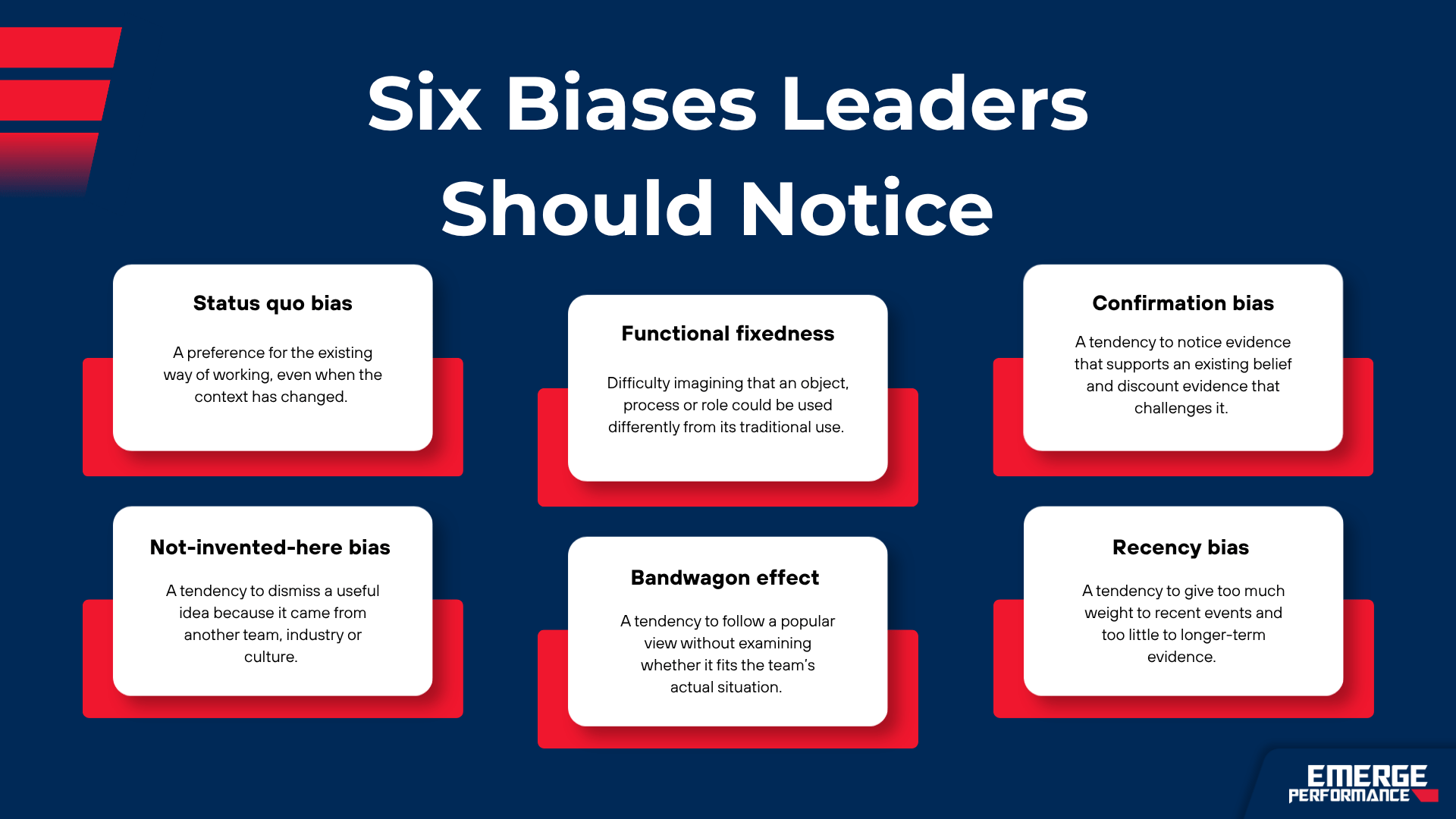
Leadership training: six cognitive biases leaders should notice

Status quo biasA preference for the existing way of working, even when the context has changed.
Functional fixednessDifficulty imagining that an object, process or role could be used differently.
Confirmation biasNoticing evidence that supports an existing belief and discounting evidence that challenges it.
Not-invented-here biasDismissing a useful idea because it came from another team, industry or culture.
Bandwagon effectFollowing a popular view without examining whether it fits the actual situation.
Recency biasGiving too much weight to recent events and too little to longer-term evidence.

Further reading for leadership development

For a complementary coaching framework, the International Coaching Federation outlines its core coaching competencies, including ethical practice, trust, active listening and facilitating growth.

A Practical Leadership Learning Routine

Biases are pervasive and often unconscious, but leaders can reduce their influence with a deliberate routine. Before an important decision, pause and ask:

  • What evidence would challenge my current view?
  • Whose perspective is missing, especially from people closest to the work or customer?
  • Am I rejecting this option because it is weak, or because it is unfamiliar?
  • What small, safe test could give us better information before we commit?
  • What will we review after the decision, and what will we change next time?

Max De Pree wrote in Leadership Is an Art: “The first responsibility of a leader is to define reality.” Leaders also need to keep checking whether the reality they have defined is still accurate. Feedback, data and honest conversation make that possible.

Leadership Lessons From Practice

Indra Nooyi’s leadership at PepsiCo is often associated with connecting business performance with a broader sense of purpose. The lesson is not to copy a single leader’s style. It is to connect performance expectations with the people, customers and long-term responsibilities affected by them.

Better leadership is less about charisma than practice. New leaders can begin with clear expectations and active listening. More experienced leaders can examine where experience has become an assumption and create conditions in which colleagues can challenge it safely.

How to Develop a Leadership Mindset

A leadership mindset starts with moving from “How do I get this done?” to “How do I help the team create the outcome?” It combines ownership with humility: setting direction, making decisions and holding standards, while remaining open to feedback and learning.

  • Treat feedback as data about the leadership experience you create for others.
  • Connect everyday decisions to the team’s purpose and the organisation’s strategy.
  • Practise reflection after important conversations, projects and setbacks.
  • Make learning visible by naming what you are testing, what you learned and what you will adjust.

Key Takeaways

  • Leadership development is a continuing practice of learning, not a one-time achievement.
  • Bias can limit learning when familiar habits are treated as facts rather than assumptions to test.
  • Better leaders seek disconfirming evidence, invite different perspectives and review decisions.
  • A strong mindset connects accountability for results with curiosity, humility and growth.

Frequently Asked Questions

What is leadership training?

Leadership training helps managers build the knowledge, behaviours and judgement needed to guide people and deliver results. Effective training combines relevant concepts with practice, feedback and reflection.

How does leadership training improve team performance?

It can improve team performance when leaders translate learning into clearer priorities, stronger feedback conversations, better decisions and more effective development of others.

How can leaders improve their leadership skills?

Start with a specific capability, ask for feedback on its effect, practise in real situations and review what changed.

What are the best leadership tips for new leaders?

Clarify priorities, set expectations early, listen before solving, hold regular one-to-ones, address issues promptly and delegate in ways that build capability.

What are the traits of successful leaders?

Successful leaders commonly demonstrate clarity, integrity, curiosity, accountability, empathy and adaptability. The real test is whether they create conditions in which people can contribute, solve problems and grow.

Develop Leadership Capability with Emerge Performance

Build the leadership habits and organisational conditions that help people perform, adapt and grow when expectations are high and change is constant.

Explore Leadership Performance Academy


×
Limited Promotion
Receive up to
50% Discount
on The Performance Coach programs

Explore The Performance Coach (TPC), an ICF Level 1 & Level 2 pathway designed to help coaches build a strong foundation and deepen their executive coaching practice.


View TPC Level 1


View TPC Level 2


×
Limited 1-for-1 Promotion
Enrol together
1-for-1 Promotion
One paid enrolment gives you two participant places

Explore The Team Coach (TTC), an
ICF-accredited team coaching pathway
designed to help coaches develop the skills to coach high-performing teams.


View TTC Programme