Train Toward Your ICF ACC Credential

The Performance Coach Level 1 is an ICF-accredited coach-training programme that builds real coaching confidence through hands-on practice, mentor support, and a clear pathway to your ACC credential—typically completed in 6–8 months.

3D illustration of an online coaching session with DISCO LMS and ConveraLab for TPC Level 1
icfLevel 1 Accredited Coach
Training Programme
60+ hoursCoach education
10+ hoursMentor coaching
5 sessionsObserved coaching practice
6–8 monthsTraining duration

Knowing coaching is not the same as being able to coach.

The Performance Coach (TPC) Level 1 goes beyond coaching theory. This ICF-accredited coach training programme helps you develop practical coaching skills through real practice, feedback and reflection, so you can coach with greater confidence in real conversations.

Explore how you’ll learn

Aspiring Professional Coaches

You want to build practical coaching skills and work towards your ICF ACC credential.

Leaders & Managers

You want to use coaching skills to lead better conversations, develop people and strengthen your leadership.

HR & L&D Professionals

You want practical, ICF-aligned coaching skills you can apply to people and leadership development in your organisation.

Professionals Exploring Coaching

You’re considering coaching as a new career, an additional professional skill, or the next step in your development.

Coaching Skills You’ll Develop in TPC Level 1

By the end of the programme, you’ll be able to:

Lead a Complete Coaching Conversation

Structure a coaching conversation from opening to meaningful action.

Build Trust & Psychological Safety

Create the conditions for open, honest coaching conversations.

Listen Beyond the Words

Notice what’s said, unsaid and emerging in the conversation.

Ask Questions That Deepen Awareness

Use thoughtful questions to help people reflect and discover new perspectives.

Coach Real-World Situations

Apply your coaching skills with confidence across different conversations and challenges.

Coach in Line with ICF Core Competencies

Develop your coaching practice around ICF standards.

Hear from our graduates

Your path to ICF ACC

Your pathway to the ICF ACC Credential: complete TPC Level 1, build your coaching experience, then apply to ICF for your ACC credential.

1

Complete ICF Level 1 Coach Training

Complete TPC Level 1 with 60+ coach education hours, 10 mentor coaching hours and a performance evaluation.

2

Complete 100 Hours of Coaching Experience

Build 100 hours of coaching experience through real client coaching and continued practice.

3

Apply & Pass the 60 Question ICF ACC Exam

Submit your ICF ACC application and complete the 60-question ACC Exam as part of the credentialing process.

4

Earn the ICF ACC Credential

Once all ICF ACC requirements are met, you can earn the Associate Certified Coach (ACC) credential.

Explore how you’ll learn

Note: The ACC credential is awarded by the International Coaching Federation (ICF). Completing TPC Level 1 supports the education and mentor coaching requirements but does not itself award the ACC credential.

How you’ll learn

Coaching is learned through practice.

Our experience is a continuous cycle of learning, practice, feedback, reflection and real-world application.

LearnLive interactive sessions
PractisePeer coaching and ConveraLab scenarios
Be observedFive observed coaching sessions
Receive feedbackMentor coaching and supervision
ReflectJournaling and self-awareness
ApplyReal conversations in real situations

What makes TPC Level 1 different?

More than a certification. A real coaching experience.

Practice is built into the programme

Live practice, observed sessions, feedback and reflection are part of the learning journey—not optional extras.

You don’t practise alone

Mentor coaching, supervision, peer coaching and The Coaching Village provide ongoing support.

Grounded in human performance

Insights from performance psychology, leadership and high-performance environments deepen your practice.

Practice beyond the classroom

ConveraLab offers more realistic coaching practice and personalised feedback between live sessions.

Programme brochure

Want the full programme details?

The brochure-download form will be connected here after its final fields and delivery method are confirmed.

Speak to an advisor in the meantime

Programme modules

What you’ll explore along the way.

01 — Introduction to coaching

Discover what makes coaching different from giving advice and build your foundation in coaching ethics and ICF competencies.

02 — Principles of human performance

Explore the behavioural and performance foundations that inform meaningful coaching conversations.

03 — Unlocking effective agreements & contracting

Learn how to establish clarity, focus and shared responsibility in coaching relationships.

Live online cohorts

Find a cohort that fits your schedule.

Choose the language and dates that work for you. Sessions are delivered live online, with flexible support if you miss a class.

What’s included

60+ education hours
10 mentor coaching hours
5 observed coaching sessions
Performance evaluation
Group supervision
Peer practice
ConveraLab access
Lifetime Coaching Village access

Cohort dates, fees and delivery language will be confirmed before publishing.

Frequently asked questions

Questions people ask before joining.

What is The Performance Coach Level 1?

It is an ICF-accredited coach-training programme designed to develop practical coaching skills through live learning, practice, feedback and mentor coaching.

Does completing TPC Level 1 make me an ICF ACC coach?

No. It supports the education and mentor-coaching elements of the pathway; ICF awards ACC only after all its requirements are met.

Is this suitable for leaders and HR professionals?

Yes. The programme is designed for people who want to use coaching to develop others and lead more effective conversations.

Do I need coaching experience before joining?

No prior formal coaching experience is required. The learning experience builds from core foundations into supervised practice.

How much real coaching practice will I get?

You will practise through live learning, peer coaching, observed sessions and realistic conversations supported by feedback.

About TPC Level 1

Build practical coaching skills that travel into real work.

The Performance Coach Level 1 by Emerge Performance is designed for leaders, HR professionals and developing coaches who want to strengthen how they listen, question, develop people and support performance.

HomeAll InsightsBlogWhy Mindfulness Matters

Why Mindfulness Matters

Does your work life involve as much last-minute “energy-charged arrows” to erupt an anxious volcano or as much serenity as the Raffles Place MRT at 9am on a Monday? If so, it’s time for a fresh approach to your corporate life.

If sitting cross-legged in the corner of your office singing ‘ommm’ doesn’t sound like your idea of a good time, you needn’t worry. Mindfulness practice is practical enough for even the harshest sceptic – no prayer beads necessary. Not only will meditation ease you into a more engaging, creative way
of life, but it will also improve your overall wellness. Every major business press from Harvard Business Review to Forbes is punting mindfulness to
transform not only the corporate workplace, but the very work we do. Corporate behemoths like Google, Aetna and Facebook are all following suit by encouraging their employees to adopt this discipline. Here’s why.

The UNC Kenan-Flagler Business School studied the benefits of mindfulness in corporate high-fliers and found that the practice of mindfulness improved communication skills and innovative
thinking while lowering negative stress reactions. Being mindful allows you to discover new ways to relate to the good, the bad and the ugly’ of whatever life throws at you. It enables you to engage with what’s unfolding in the present moment instead of grappling aimlessly with the woulda coulda shouldas’.

Make no mistake: this is not a simple practice – especially for the stress junkies of today who find sitting in silence a daunting task. In one study by the University of Virginia, a group of men were given the option of sitting quietly or giving themselves an electric shock. Guess what 65% of them chose? The electric shock.

Mindfulness is not just abstract talk. A team of scientists from the University of British Columbia and Chemnitz University of Technology found that the practice of mindfulness appeared to enhance specific brain regions related to perceptivity, pain tolerance, emotional resilience, complex
thinking and self-awareness. Translating this into practical terms, mindfulness can keep you from sending emails you will later regret, it can eliminate the need to have awkward and lonely lunches by yourself, and it can help you solve problems effectively and make clearer decisions. What’s more, your
body’s level of cortisol – the hormone to blame for all the stress that’s been causing you to down sedatives – also decreases and your immune system
becomes stronger.

According to Jon Kabat-Zinn, the godfather of contemporary mindfulness, there are seven attitudes of mindfulness that form the building blocks of one’s
practice. Practice’ being the operative word. No one becomes more mindful by attending a talk by Kabat-Zinn. This is a practice that is lived and breathed in our everyday lives. It’s not what you do, it’s how you do it, and that’s intention and attitude in action. Let’s elaborate on the first two attitudes.

First Attitude: Non-Judging

This attitude takes some practice because it introduces a concept that’s wildly foreign to conventional wisdom. We have all been so conditioned to make judgement on thoughts, events and feelings – stamping them with a ‘pleasant’ or ‘unpleasant’ label – that we don’t even realise that we are now driven
by such judgements unconsciously. This attitude is about suspending this ongoing judgement and relating to our experiences in an impartial manner.

If your supervisor were in a destructive mood, it would be instinctive to go into a judging mode. The key here is to not judge the judging and simply become
aware of it without reacting to it. By bringing consciousness to the moment, we find the space and pause to choose our response instead of resorting to the mindless reaction of going into full battle-mode.

Second Attitude: Acceptance

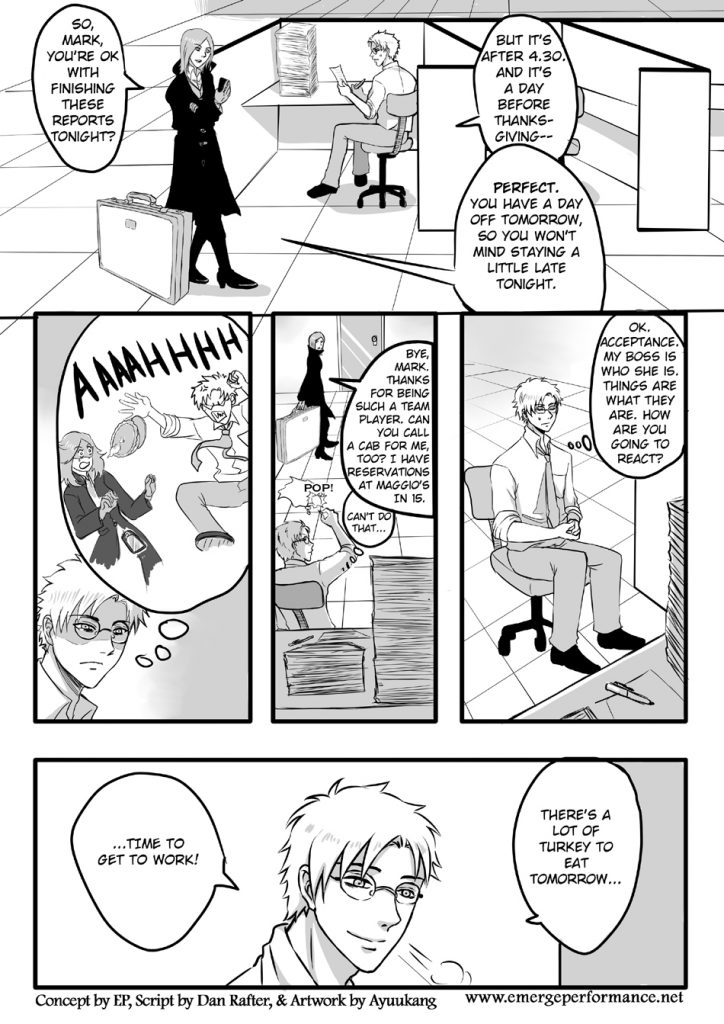
Time will always tick no matter how hard we try to manipulate it. Colleagues get promoted ‘unfairly’ and others just get lucky all the time. Acceptance is about seeing things as they are. Every second you open your palms to receive reality is a second you save on hand-wringing.

The world will not be as ideal as you want it to be, your boss will not stop being indecisive and your chaotic morning is unlikely to become less full of chaos. These represent wants and desires, but we don’t live in the future. We are alive only in the present. Only when we truly accept what is going on can we move forward. And if reality still bites, know that embracing the bite only makes you stronger.

Mindfulness is a conscious commitment to our intentions. For some of us it starts with suspending the judgement of our self-critic; for some it is about opening our palms to reality. Living is about experiencing life to the fullest – the good, the bad and the ugly. So let’s roll up our sleeves and get to work, just like Mark.

Check out our latest Mindfulness-Based Stress Reduction (MBSR) Program. 


×
Limited Promotion
Receive up to
50% Discount
on The Performance Coach programs

Explore The Performance Coach (TPC), an ICF Level 1 & Level 2 pathway designed to help coaches build a strong foundation and deepen their executive coaching practice.


View TPC Level 1


View TPC Level 2


×
Limited 1-for-1 Promotion
Enrol together
1-for-1 Promotion
One paid enrolment gives you two participant places

Explore The Team Coach (TTC), an
ICF-accredited team coaching pathway
designed to help coaches develop the skills to coach high-performing teams.


View TTC Programme