A growth conversation is an ongoing, two-way discussion that
connects performance, learning, future contribution, and the support an
employee needs to succeed. It does not remove accountability or
make formal reviews unnecessary. Instead, it prevents one annual meeting
from carrying the full burden of feedback, development, goal alignment,
and career planning.
This distinction matters. Performance management is
broader than a review form or rating cycle. The CIPD
describes effective performance management as a two-way process built
around regular, open, supportive discussion, clear objectives,
resources, development, and accountability. Growth conversations are one
practical way to make that principle visible in everyday management.
Table of Contents
What Is a Growth Conversation?
A growth conversation is a recurring discussion between an
employee and manager about four connected areas: current
performance, learning from recent experience, future priorities, and the
conditions needed for progress. It is usually shorter and more frequent
than a formal performance review, and it should allow both people to
contribute.
The term is not an official International Coaching Federation
(ICF) methodology. In this article, it describes a management
practice that uses coaching skills – such as listening, inquiry,
reflection, and shared action planning – within the realities of a
manager-employee relationship.
That final point is important. A manager is not a neutral external
coach. Managers set expectations, allocate work, assess performance, and
make decisions. The goal is therefore not to turn every management
discussion into a coaching session. It is to use a more thoughtful
balance of inquiry, feedback, direction, and accountability.
Why Annual Performance Reviews Often Fall Short
The problem is not that a formal review exists. The problem
is treating it as the main place where performance and development are
discussed. When feedback is delayed for months, employees lose
the opportunity to adjust while the work is still fresh, and managers
are more likely to rely on recent or memorable events rather than the
full performance period.
Gallup reports that only two in ten employees say their
performance is managed in a way that motivates them to do outstanding
work. It also reports that only 14% strongly agree their
performance reviews inspire them to improve. These figures do not prove
that every annual review is ineffective, but they do suggest that many
performance systems are not creating the developmental value
organizations expect.
Source: Gallup,
Transform Performance Management
1. Feedback arrives too late
A conversation about a client meeting six months later is less useful
than a short discussion the same week. Timely feedback gives employees a
chance to connect the observation with the actual behavior, understand
its impact, and test a different approach.
2. Evaluation and development compete for attention
When pay, promotion, ratings, and career development are compressed
into one meeting, the evaluative issues usually dominate. Employees may
listen for the decision rather than engage openly in learning.
Separating ongoing development conversations from formal decision points
can improve the quality of both.
3. The conversation becomes one-way
A review can become a manager delivering conclusions while the
employee waits to respond. Growth conversations begin with dialogue:
What happened? What did each person notice? What is working? What needs
to change? What support is missing?
4. More feedback is assumed to be better feedback
Frequency matters, but quality matters more. A CIPD
evidence review cautions that feedback can improve performance
but can also demotivate or harm performance when it is vague, poorly
delivered, focused on the person rather than observable behavior, or
disconnected from a realistic path forward.
Growth Conversations vs. Performance Reviews
The two practices serve different purposes. Strong performance
systems use them together rather than forcing one process to do
everything.
| Dimension | Formal performance review | Growth conversation |
|---|---|---|
| Primary purpose | Summarize and evaluate a defined period | Improve performance and capability while work is unfolding |
| Typical cadence | Annual, biannual, or quarterly | Brief and recurring; often monthly, biweekly, or linked to key work |
| Time orientation | Primarily retrospective | Reflective and forward-looking |
| Conversation flow | Often manager-led | Two-way dialogue with shared reflection |
| Evidence | Consolidated results, ratings, and documentation | Recent examples, goals, observations, stakeholder input, and learning |
| Accountability | Formal decisions and documented outcomes | Clear commitments, support, and near-term follow-through |
| Best output | A fair record and clear decision | A small number of meaningful actions and greater clarity |
Should Organizations Replace Performance Reviews?
Not necessarily. Organizations still need clear
objectives, fair performance decisions, documented expectations, and
appropriate processes for compensation, promotion, development, and
underperformance. Depending on company policy and local law, formal
records may also be important.
The stronger redesign is usually to separate the roles of the
system:
-
Use growth conversations for ongoing learning, alignment,
recognition, course correction, and support. -
Use formal reviews for consolidated assessment, calibration,
documented decisions, and longer-term career or reward
discussions. -
Use clear escalation and performance improvement processes when
expectations are repeatedly not met.
This avoids two common extremes: keeping a bureaucratic review cycle
that adds little value, or removing structure so completely that
employees no longer understand how performance decisions are made.
A Five-Step Framework for Effective Growth Conversations
A growth conversation does not need to be long. A focused 20- to
40-minute discussion can be useful when it follows a clear sequence and
ends with shared commitments.
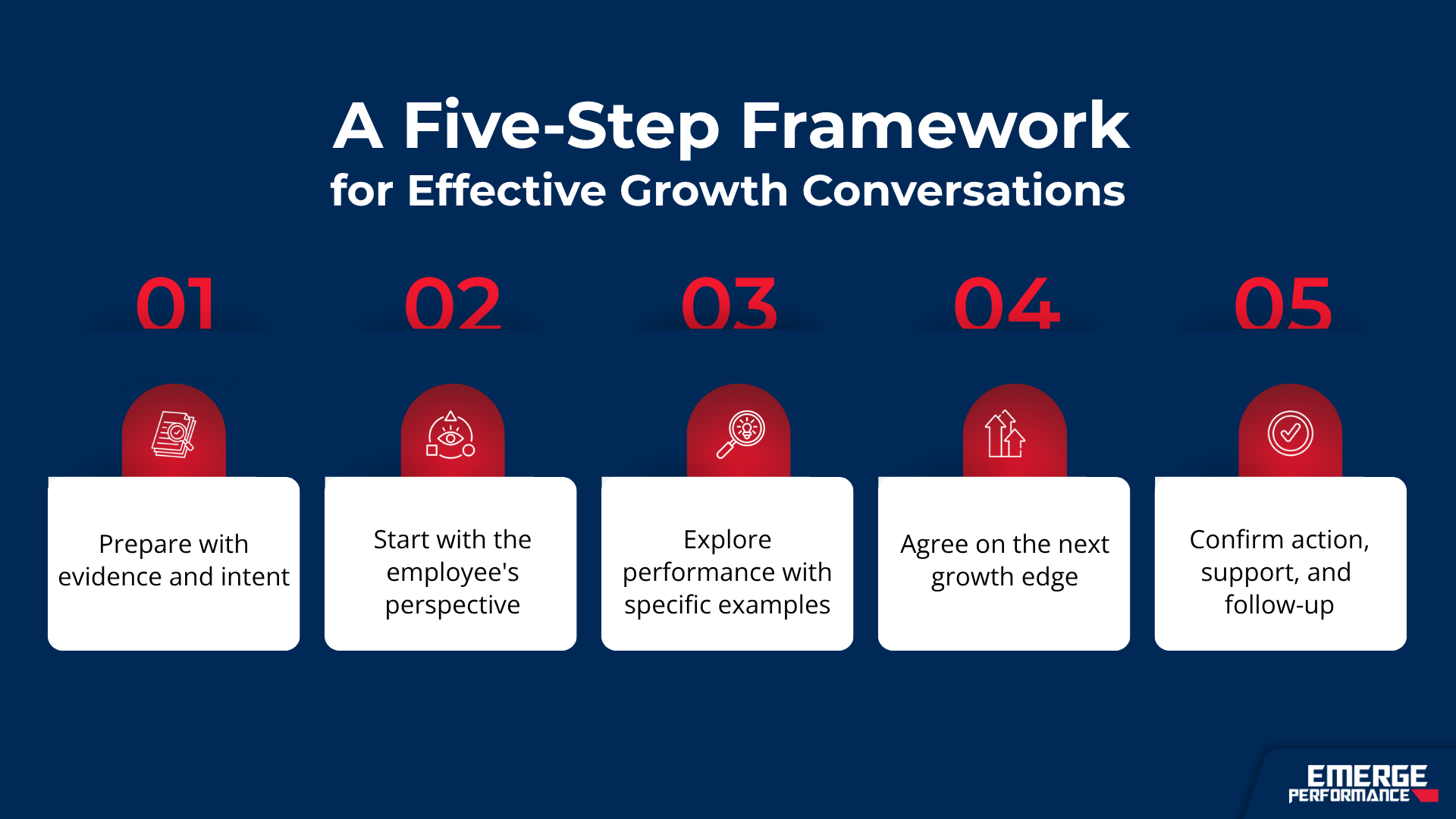
Step 1: Prepare with evidence and intent
Review the employee’s goals, recent work, commitments from the
previous conversation, and any relevant stakeholder input. Choose one or
two priorities rather than trying to discuss everything. Enter the
conversation with a developmental intent, while remaining ready to
address performance gaps directly.
Step 2: Start with the employee’s perspective
Invite reflection before offering your interpretation. This reduces
assumptions and reveals context the manager may not have seen. Ask what
the employee is proud of, what was difficult, and what they learned.
Step 3: Explore performance with specific examples
Discuss both outcomes and behaviors. Describe observable events
rather than making broad judgments about personality. Recognize
effective work, identify the impact of any gap, and test whether
expectations were clear and realistic.
Step 4: Agree on the next growth edge
Choose the capability, behavior, or result that would make the
greatest difference next. A useful growth edge is specific enough to
practice and relevant enough to matter to the employee, team, and
business.
Step 5: Confirm action, support, and follow-up
End with a small number of commitments. Clarify what the employee
will do, what the manager will provide, how progress will be observed,
and when the conversation will continue. Document decisions and
commitments – not every sentence.
Questions Managers Can Use in Growth Conversations
Good questions create reflection, but they should not become a script
that prevents honest feedback. Select the questions that fit the
situation.
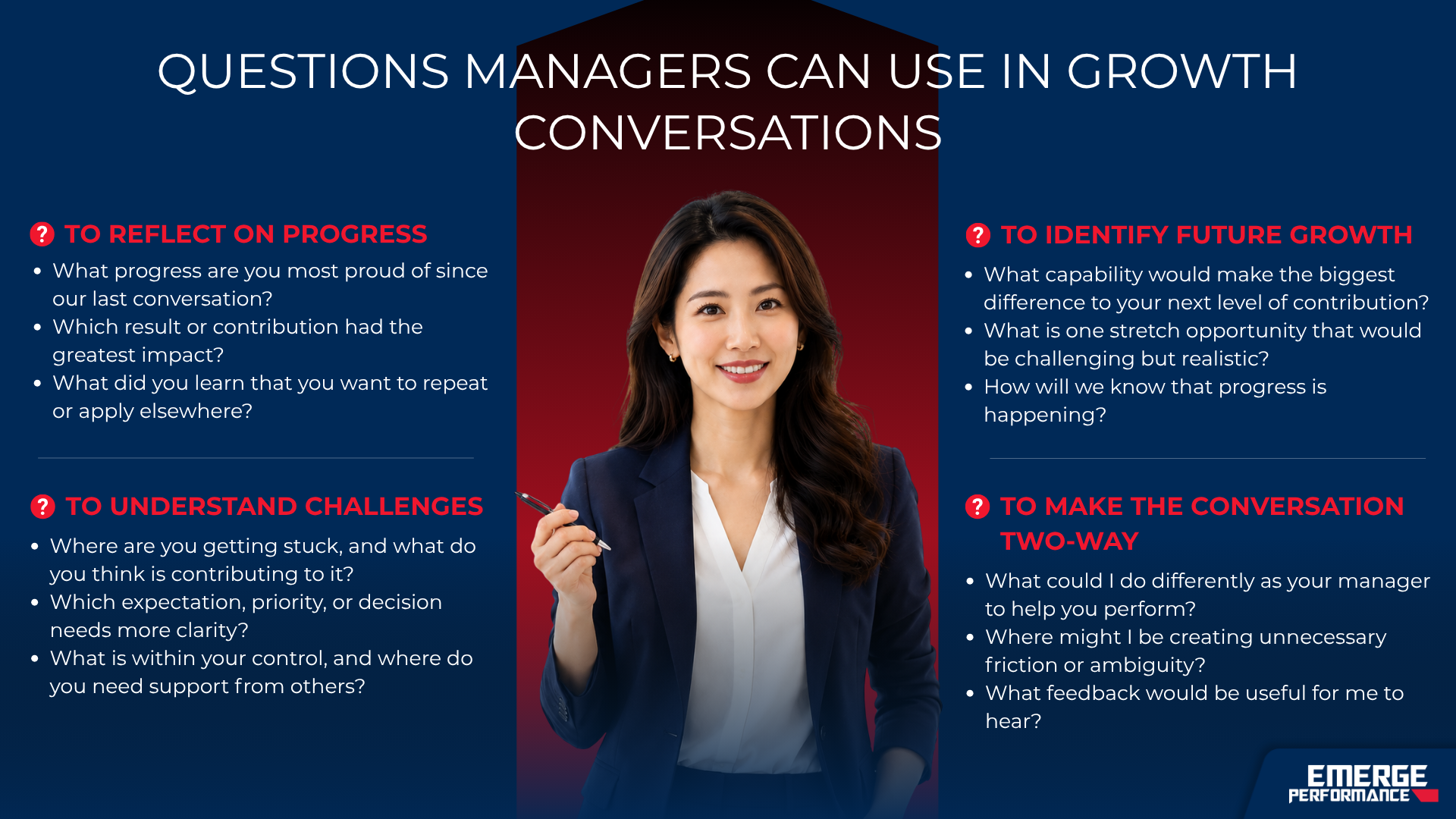
To reflect on progress
-
What progress are you most proud of since our last
conversation? -
Which result or contribution had the greatest impact?
-
What did you learn that you want to repeat or apply
elsewhere?
To understand challenges
-
Where are you getting stuck, and what do you think is
contributing to it? -
Which expectation, priority, or decision needs more
clarity? -
What is within your control, and where do you need support from
others?
To identify future growth
-
What capability would make the biggest difference to your next
level of contribution? -
What is one stretch opportunity that would be challenging but
realistic? -
How will we know that progress is happening?
To make the conversation two-way
-
What could I do differently as your manager to help you
perform? -
Where might I be creating unnecessary friction or
ambiguity? -
What feedback would be useful for me to hear?
How to Give Corrective Feedback Without Creating Unnecessary Defensiveness
Developmental conversations still need candor. Avoiding difficult
feedback in the name of psychological safety can create confusion and
unfairness. The aim is to be direct about the work while remaining
respectful toward the person.
A practical sequence is:
-
Describe the context: identify the specific moment or piece of
work. -
Name the observable behavior: explain what was said or done
without labeling the person. -
Explain the impact: connect the behavior to the customer, team,
result, or working relationship. -
Invite reflection: ask what the employee noticed and what context
should be considered. -
Agree on the next step: define what needs to happen differently
and how the manager will support it.
How to Measure Performance in a Continuous System
Moving toward growth conversations does not mean replacing
evidence with good intentions. Performance should still be
defined, observed, and discussed. The difference is that evidence is
used regularly to guide improvement rather than appearing only at the
end of the cycle.
| Performance area | Possible evidence | Useful cadence | Growth question |
|---|---|---|---|
| Results | Goals, KPIs, project milestones, quality, customer outcomes | Monthly or by milestone | What is on track, and where is a course correction needed? |
| Ways of working | Observed behavior, collaboration, decision quality, reliability | Close to relevant events | Which behavior is helping or limiting the result? |
| Capability growth | Practice, stretch assignments, feedback, demonstrated skill | Monthly or quarterly | What can the employee now do more effectively? |
| Stakeholder experience | Customer, peer, team, or partner input | At meaningful points | What pattern is emerging across different perspectives? |
| Sustainable performance | Workload signals, recurring blockers, role clarity, recovery needs |
During regular check-ins | What conditions support strong performance without avoidable overload? |
One practical case comes from Novartis. In a
large-scale experiment involving more than 16,000 employees across eight
countries, its redesigned performance approach was preferred by
employees, and fewer than 5% wanted to return to the previous process.
Reported agreement that employees received quality feedback that helped
them develop increased by 29%. This is a case study rather than
universal proof, but it illustrates the value of testing a new model
with data rather than relying on fashion or assumptions.
Source: CIPD
case study: Novartis
How HR Can Introduce Growth Conversations
Changing the name of a meeting is easy. Changing the quality of
management practice requires clearer design, capability building, and
reinforcement. A focused 90-day pilot can help organizations learn
before scaling.
Days 1-30: Design the minimum viable approach
-
Clarify which decisions remain in the formal review and which
belong in ongoing conversations. -
Define a small number of conversation principles, such as timely,
specific, two-way, future-focused, and accountable. -
Create a lightweight template for goals, observations,
commitments, and support. -
Select a pilot group with managers who are willing to learn and
provide honest feedback.
Days 31-60: Build manager capability and pilot
-
Train managers to listen, ask useful questions, give
behavior-based feedback, address performance gaps, and agree on
actions. -
Use realistic practice scenarios rather than relying only on
conceptual training. -
Ask employees what made conversations useful or
unhelpful. -
Track whether commitments are followed through, not just whether
meetings occurred.
Days 61-90: Review evidence and refine
-
Compare employee and manager experiences before and after the
pilot. -
Review goal clarity, feedback usefulness, follow-through, and
confidence in performance decisions. -
Identify where the process is too heavy, too vague, or
inconsistently applied. -
Adjust the system before expanding it across the
organization.
Common Mistakes to Avoid
Renaming the review without changing the experience.
A “growth conversation” that remains a top-down rating discussion will
quickly lose credibility.
Prioritizing frequency over usefulness. A weekly
meeting with no clear purpose can become another administrative burden.
Match the cadence to the work and the employee.
Replacing accountability with encouragement.
Recognition and empathy matter, but employees also need clarity about
expectations, gaps, consequences, and decisions.
Using questions when direct guidance is needed.
Coaching questions are useful when reflection and ownership are
possible. In a safety-critical, urgent, or unfamiliar task, clear
instruction may be more appropriate.
Discussing only weaknesses. A developmental
conversation should build on strengths, recognize contribution, and
address the most important gaps.
Failing to document commitments. A short written
summary improves continuity and fairness. Record goals, agreed actions,
support, and the follow-up date.
Frequently Asked Questions
What is the difference between a growth conversation and a performance review?
A performance review consolidates and evaluates performance over a
defined period, often for formal decisions. A growth conversation is
shorter, more frequent, and focused on learning, alignment, course
correction, and future contribution.
How often should growth conversations happen?
There is no universal frequency. Many teams benefit from monthly or
biweekly discussions, with shorter feedback close to important events.
The right cadence depends on the work, employee experience, pace of
change, and level of support needed.
Can growth conversations replace annual reviews?
They can replace some developmental elements of an annual review, but
organizations may still need formal assessment, calibration,
documentation, and decisions about pay, promotion, or underperformance.
The better question is which purpose belongs in which conversation.
Should growth conversations be documented?
Yes, but lightly. Record goals, key observations, agreed actions,
support, and the next follow-up. Avoid turning the conversation into a
transcript or creating unnecessary administration.
Are growth conversations the same as coaching?
No. Managers can use coaching skills, but they retain authority and
accountability for the work. Professional coaching is a distinct
practice with its own ethical standards, role boundaries, and, where
relevant, ICF Credentials and accredited coach education.
What if an employee is underperforming?
Address the issue early and directly. Clarify the expected standard,
describe the observed gap, understand contributing factors, agree on
specific improvement actions, and follow the organization’s formal
process where needed. Growth-oriented does not mean avoiding
consequences.
Key Takeaways
-
Growth conversations are ongoing, two-way discussions about
performance, learning, future contribution, and support. -
They strengthen formal performance management; they do not
automatically replace reviews, ratings, or accountability
processes. -
Useful feedback is timely, specific, behavior-based, relevant to
the work, and connected to a realistic next step. -
Managers need to balance coaching skills with clear direction and
fair performance decisions. -
Organizations should pilot, measure, and refine the approach
before scaling it.
Conclusion: Review Less, Learn More
The future of performance management is not a choice between rigid
annual reviews and unstructured conversation. Organizations need both
clarity and humanity: clear expectations, fair evidence, honest
feedback, meaningful development, and consistent follow-through.
Growth conversations create a rhythm in which people can reflect,
adjust, and build capability before the end of the year. When formal
reviews finally happen, there should be fewer surprises because the
important conversations have already taken place.
A useful question for leaders and HR teams is therefore not simply,
“Should we remove performance reviews?” It is: “How can every
conversation help people understand what good performance looks like and
make meaningful progress toward it?”
The Coaching Village
Free to join
Keep the growth conversation going.
Join a free learning community where leaders and coaches turn insight into stronger everyday practice—together.