“Future-ready” appears in strategy presentations, transformation plans and leadership conversations so often that it can begin to sound like another corporate label. Yet the underlying challenge is real: organisations must continue to perform while technology, customer expectations, workforce needs and market conditions change around them.
A future-ready organisation is not one that can predict every disruption. It is one that has built the capability to sense change, make thoughtful decisions, adapt quickly, learn continuously and sustain trust through uncertainty.
The urgency is visible in the World Economic Forum’s Future of Jobs Report 2025: 63% of surveyed employers identified skills gaps as the leading barrier to business transformation, while organisational culture and resistance to change were cited by 46%. The same report places analytical thinking, resilience, flexibility, agility and leadership among the capabilities organisations need most.
|
The central idea Future readiness is not a destination. It is an organisational muscle: the ability to sense, decide, adapt, learn and renew – repeatedly. |
|---|
Table of Contents
- What future-ready means
- A simple capability model
- Why future readiness matters now
- Seven future-ready capabilities
- Capability checklist
- Assess your organisation’s readiness
- A practical 90-day roadmap
- How to measure progress
- Common mistakes
- Frequently asked questions
What Does “Future-Ready” Mean in an Organisational Context?
A future-ready organisation has the leadership, workforce, systems, and routines needed to respond to change without relying on constant crisis management. Readiness is visible in how the organisation works today, not only in what its strategy document promises for tomorrow.
Future-ready is not the same as future-proof
“Future-proof” implies that an organisation can protect itself from uncertainty. In practice, no structure, technology or five-year plan can remove uncertainty. Future readiness is more realistic: it builds adaptive capacity so the organisation can respond when assumptions change.
Future-ready is not the same as technology-ready
Technology matters, but digital tools alone do not create readiness. A company can invest heavily in AI and still struggle if decision rights are unclear, employees lack confidence, data quality is weak or leaders treat change as a communication exercise rather than a capability-building process.
Future readiness connects strategy, people and execution
At its best, future readiness integrates three questions: Where is the environment changing? What capabilities will we need? How must we organise and lead differently to turn those capabilities into results?
A Simple Future-Ready Capability Model
|
1. Sense Notice shifts in customers, technology, talent and risk. |
2. Decide Translate signals into priorities, choices and clear decision rights. |
3. Adapt Redeploy people, resources, processes and technology. |
4. Learn & Renew Test assumptions, learn from evidence and update the system. |
|---|
These four actions are mutually reinforcing. Sensing without deciding creates analysis paralysis. Deciding without adapting produces plans that never reach the frontline. Adapting without learning creates change fatigue. Learning without renewal turns insight into another report rather than better performance.
Why Future Readiness Matters Now
Future readiness has become a strategic concern because multiple forms of change are arriving at the same time. The World Economic Forum identifies technology, economic uncertainty, demographic shifts, geoeconomic fragmentation and the green transition as major forces reshaping work through 2030.
Skills are changing faster than traditional planning cycles
The capability gap is not limited to technical knowledge. The World Economic Forum reports that AI and big data are among the fastest-growing skill areas, while creative thinking, resilience, flexibility, agility, curiosity and lifelong learning are also rising in importance. This means organisations need both digital fluency and the human capacity to interpret, collabourate and adapt.
AI adoption creates both opportunity and responsibility
AI can improve productivity, decision support and service design, but adoption without governance can introduce new risks. The US National Institute of Standards and Technology (NIST) recommends integrating trustworthiness considerations into the design, development, use and evaluation of AI systems. Future-ready organisations therefore build AI capability and AI governance together.
The quality of adaptation matters as much as speed
Fast change is not automatically good change. Organisations that repeatedly restructure, add new tools or launch initiatives without removing old work often create overload rather than agility. Sustainable readiness requires clarity, prioritisation and the psychological capacity to absorb change.
Seven Capabilities of a Future-Ready Organisation
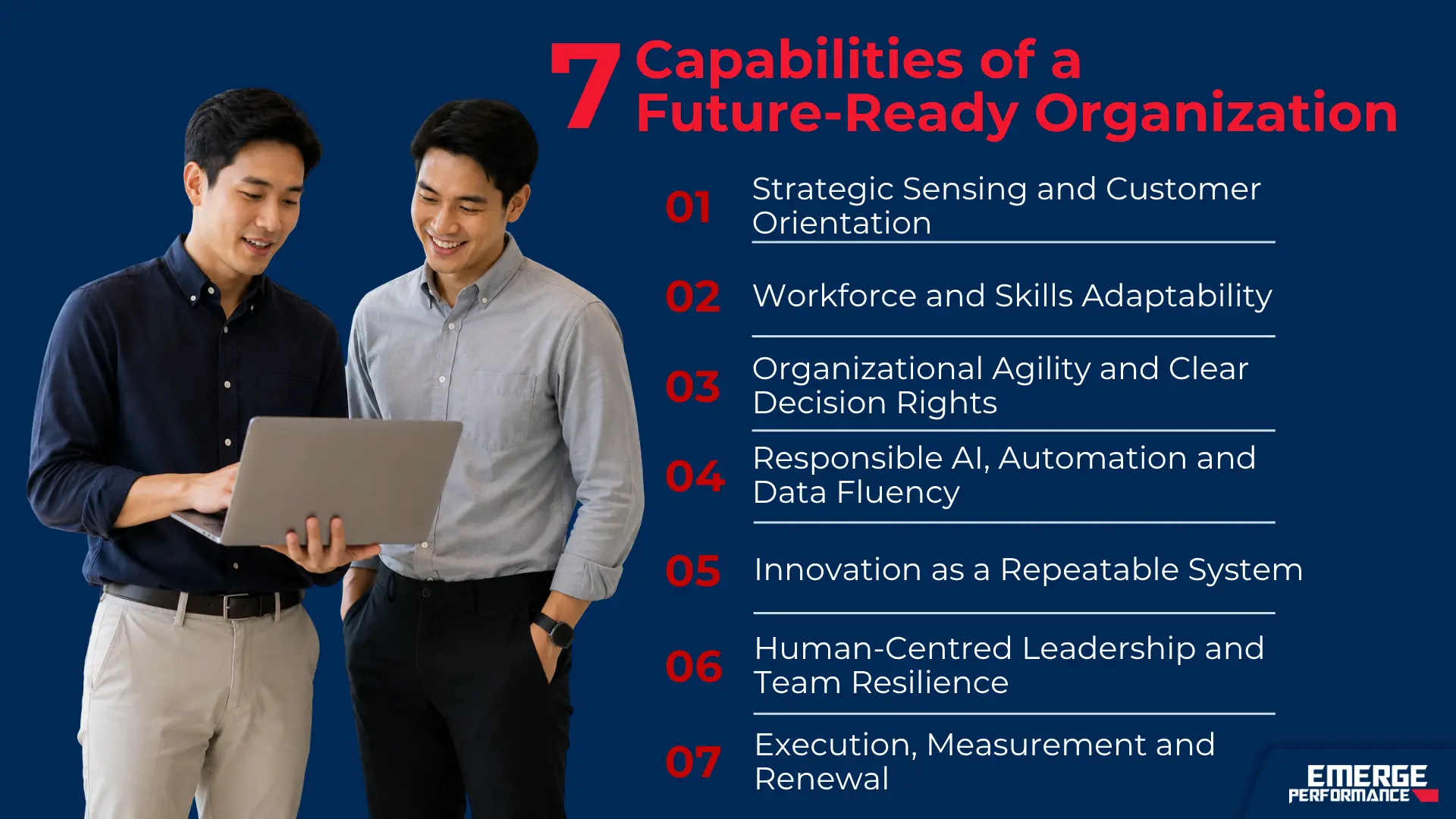
1. Strategic Sensing and Customer Orientation
Future-ready organisations do not wait for an annual strategy cycle to notice that customer needs, regulations, technology, or competitors have shifted. They build regular ways to gather signals and challenge assumptions.
This is not simply about collecting more information. It is about connecting external signals to strategic choices. Customer feedback, employee insight, operational data and market intelligence must shape priorities rather than sit in separate dashboards.
What this looks like in practice:
-
Leadership teams review emerging risks and opportunities at a regular cadence.
-
Customer journeys and stakeholder outcomes influence investment decisions.
-
Teams distinguish weak signals from noise and test assumptions before scaling action.
-
Leaders can explain what the organisation will stop, not only what it will start.
|
Leadership question What evidence would cause us to change our current strategy or operating assumptions? |
|---|
2. Workforce and Skills Adaptability
A future-ready workforce is not one in which every employee has mastered the latest tool. It is one in which people can learn, unlearn and apply new capabilities as work changes. This requires more than a catalogue of courses.
Strategic workforce planning links business direction to the skills the organisation will need, the skills it already has and the gaps it must close. The CIPD describes workforce planning as balancing labour and skills supply against future demand so the organisation can deliver its short- and long-term objectives.
What this looks like in practice:
-
Critical capabilities are identified by role, team and strategic priority.
-
Employees have opportunities to practice new skills in real work, not only in training rooms.
-
Internal mobility, mentoring, coaching and stretch assignments support development.
-
Leaders treat learning time as an investment rather than an optional benefit.
|
Leadership question Which capabilities will become more important over the next 12-24 months, and where will people gain real opportunities to practise them? |
|---|
3. Organisational Agility and Clear Decision Rights
Agility is often mistaken for working faster. In reality, organisational agility is the ability to redirect attention, resources, and expertise as conditions change – without creating confusion about accountability.
Different operating models can support this. McKinsey’s helix model, for example, separates day-to-day business accountability from people and capability leadership through two parallel lines of accountability. The model is not a universal answer, but it illustrates a useful principle: flexibility improves when decision rights and capability ownership are explicit.
What this looks like in practice:
-
Teams know which decisions they can make without escalation.
-
Resources can move toward priorities without requiring a full reorganisation.
-
Cross-functional work has a clear purpose, sponsor, owner and decision process.
-
Governance removes friction instead of adding meetings and approvals.
|
Leadership question Where does work currently slow down because ownership, authority or escalation paths are unclear? |
|---|
4. Responsible AI, Automation and Data Fluency
Future-ready organisations use AI and automation to improve work, but they do not assume every task should be automated. They identify where technology can reduce low-value effort, strengthen decisions or create better customer and employee experiences – while keeping human accountability clear.
Data democratization also requires discipline. Giving more employees access to information is useful only when data is reliable, definitions are consistent, and people understand how to interpret it. Access without data literacy can spread confusion faster.
What this looks like in practice:
-
AI use cases begin with a defined business or user problem.
-
Employees receive role-relevant AI and data literacy, not generic awareness alone.
-
Governance addresses privacy, security, bias, human oversight and accountability.
-
The organisation measures whether automation actually improves quality, speed or experience.
|
Leadership question Where can technology augment human judgement, and where must responsibility remain unmistakably human? |
|---|
5. Innovation as a Repeatable System
Innovation is not sustained by asking people to “think outside the box.” It needs a system that helps teams identify opportunities, test ideas, learn from evidence and decide what to scale, adapt or stop.
ISO 56002 provides guidance for establishing and continually improving an innovation management system. Its relevance is practical: innovation becomes more reliable when leadership, strategy, processes, resources, learning and evaluation support one another.
What this looks like in practice:
-
Teams can run small, bounded experiments with clear hypotheses and safeguards.
-
Learning from an unsuccessful test is valued when the test was disciplined and informative.
-
Ideas are evaluated against customer value, strategic fit and evidence – not seniority alone.
-
The organisation has a clear pathway from experiment to adoption and scale.
|
Leadership question What is the smallest safe experiment that would help us learn whether this idea deserves further investment? |
|---|
6. Human-Centred Leadership and Team Resilience
Future readiness depends on people being able to think, speak and collabourate under pressure. Technology can generate options and automate tasks, but leadership still carries responsibility for judgment, ethics, meaning, trust and difficult trade-offs.
Resilience should not become a demand for employees to absorb unlimited change. Healthy resilience combines individual skills with supportive systems: realistic priorities, recovery, psychological safety, constructive challenge and access to help.
What this looks like in practice:
-
Leaders communicate uncertainty honestly without creating unnecessary alarm.
-
Teams can raise concerns, question assumptions and discuss mistakes without fear of humiliation.
-
Managers use coaching conversations to build ownership rather than supplying every answer.
-
Performance expectations are paired with resources, role clarity and sustainable ways of working.
|
Leadership question Are we building people’s capacity to navigate change, or simply asking them to tolerate more of it? |
|---|
7. Execution, Measurement and Renewal
Future-ready organisations turn insight into operating routines. They define what progress looks like, track both outcomes and leading indicators, and revisit decisions as evidence changes.
Measurement should go beyond activity counts such as training attendance or the number of AI pilots. The more useful question is whether capability is changing how decisions are made, how quickly teams learn, and how reliably the organisation creates value.
What this looks like in practice:
-
Each transformation priority has an owner, measurable outcomes, and review cadence.
-
Leaders monitor adoption, behaviour change and business impact – not launch completion alone.
-
Teams use retrospectives to identify what to retain, improve or stop.
-
Capabilities are refreshed as strategy, technology and workforce conditions evolve.
|
Leadership question What evidence will tell us that readiness is improving – and what will we do if it is not? |
|---|
Future-Ready Capability Checklist
| Capability | Healthy signal | Warning sign |
|---|---|---|
| Strategic sensing | Signals influence priorities and choices. | Strategy remains fixed despite new evidence. |
| Skills adaptability | People build and apply capabilities in real work. | Training is disconnected from role and strategy. |
| Organisational agility | Decision rights and accountability are clear. | Cross-functional work depends on repeated escalation. |
| AI and data | Technology is useful, governed and human-centred. | Tools are adopted without clear value or oversight. |
| Innovation system | Experiments create evidence and inform investment. | Innovation depends on isolated champions. |
| Human leadership | Candour, coaching and sustainable performance coexist. | Change is driven through pressure and one-way communication. |
| Execution and renewal | Progress is measured and routines evolve. | Success is defined by launches rather than outcomes. |
How to Assess Your Organisation’s Readiness
A useful assessment should create conversation, not a false sense of precision. Ask a cross-functional group to score each statement from 1 (rarely true) to 5 (consistently true), then discuss the evidence behind the scores.
-
We notice and discuss changes in customers, technology, talent, and risk before they become urgent.
-
Our strategic priorities are clear enough to guide trade-offs and stop lower-value work.
-
We know which workforce capabilities will matter most over the next 12-24 months.
-
Decision rights are clear at the level where work happens.
-
Our AI and data practices create measurable value and include appropriate governance.
-
Teams can run disciplined experiments and learn from results.
-
People can raise concerns, challenge assumptions and ask for support.
-
We measure whether new capabilities change behaviour and performance.
|
How to interpret the discussion The lowest score is not automatically the first priority. Look for the capability that most constrains the others. For example, more innovation training will have limited impact if decision-making is slow or employees do not feel safe to challenge established assumptions. |
|---|
A Practical 90-Day Roadmap
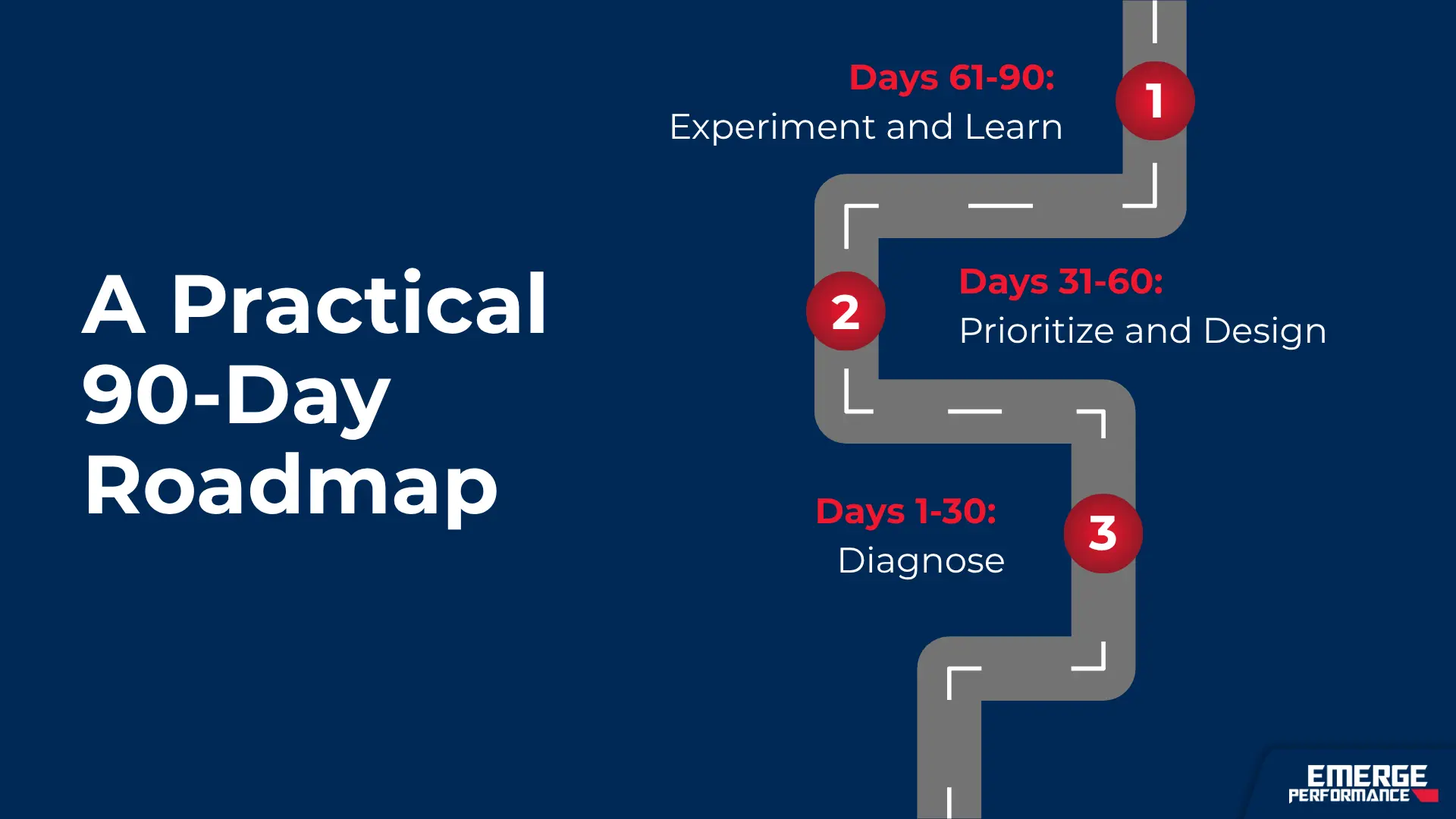
| Days 1-30: Diagnose | Days 31-60: Prioritise and Design | Days 61-90: Experiment and Learn |
|---|---|---|
|
|
|
The aim of the first 90 days is not to declare the organisation “future-ready.” It is to establish a repeatable cycle of diagnosis, prioritisation, experimentation, and learning.
How Should Future Readiness Be Measured?
No single metric can capture future readiness. A balanced view combines leading indicators of capability with business and people outcomes.
-
Strategic sensing: Time from new signal to leadership decision; assumptions tested; customer insight used in priority setting.
-
Skills: Critical-skill coverage; application of learning; internal mobility; time to proficiency.
-
Agility: Decision cycle time; escalation rate; resource redeployment time; cross-functional delivery reliability.
-
AI and data: Adoption by relevant roles; quality or productivity improvement; incidents and governance exceptions; user trust.
-
Innovation: Experiment cycle time; percentage of tests producing a decision; learning transferred across teams.
-
Leadership and resilience: Psychological safety; role clarity; sustainable workload; quality of manager conversations.
-
Execution: Benefits realised; adoption and behaviour change; initiatives stopped or simplified; review actions completed.
Common Mistakes to Avoid
Treating future readiness as an AI program
AI is one capability within a wider system. Without skills, governance, workflow redesign and leadership judgment, adoption may add risk or complexity rather than readiness.
Launching too many transformation priorities
An organisation cannot become more adaptive by overloading the same people. Prioritization and stopping work are part of readiness.
Using one-off training as the main solution
Learning creates capability only when people can practice, receive feedback and apply new skills to meaningful work.
Confusing agility with constant restructuring
Repeated structural change can weaken clarity and trust. Agility often comes from better decision rights, routines and resource allocation rather than a new organisation chart.
Opening data without strengthening literacy and governance
Data access is useful only when people can interpret it and understand its limits, definitions and responsibilities.
Making resilience an individual burden
Resilience training cannot compensate for chronic overload, conflicting priorities or unsafe leadership behaviour.
Frequently Asked Questions
What is a future-ready organisation?
A future-ready organisation can sense change, make clear choices, adapt its people and operating model, use technology responsibly and learn continuously while sustaining performance and trust.
What is a future-ready workforce?
A future-ready workforce has the technical, cognitive, interpersonal and self-management capabilities needed to respond as roles and business needs evolve. It is supported by learning opportunities, mobility, coaching and thoughtful workforce planning.
What skills are most important for the future of work?
The precise mix varies by sector and role. Current global evidence highlights analytical thinking, AI and data skills, technological literacy, creative thinking, resilience, flexibility, agility, curiosity, lifelong learning and leadership.
Does future-ready mean AI-first?
No. AI can be an important enabler, but readiness begins with a clear problem, responsible governance and the ability to redesign work. Organisations should be purpose-led and human-accountable, not technology-led by default.
How can leaders begin building future readiness?
Start with strategy and evidence. Identify the external changes that matter, assess the seven capabilities, choose the most constraining gap, and run a small 90-day experiment with clear outcomes and a review cadence.
Can a small or medium-sized organisation become future-ready?
Yes. Smaller organisations may have fewer resources, but they can benefit from shorter decision paths and closer customer contact. The key is to focus on a small number of critical capabilities rather than copying the systems of a large enterprise.
Key Takeaways
-
Future readiness is the repeatable ability to sense, decide, adapt, learn and renew.
-
Technology is important, but organisational capability depends equally on skills, decision clarity, innovation systems, leadership and trust.
-
The strongest starting point is not a large transformation program; it is a focused diagnosis and a small, measurable experiment.
-
Readiness should be measured through behaviour and outcomes, not the number of initiatives launched.
-
A future-ready organisation keeps updating how it works as evidence and conditions change.
Conclusion: Build the Capacity to Meet the Future as It Emerges
The future will not arrive as a single event. It will appear through changing customer expectations, new technologies, different workforce needs, market shifts and unexpected disruptions. Organisations do not need perfect foresight, but they do need the capacity to respond with clarity and care.
That capacity is built through everyday choices: how leaders listen, how decisions are made, how people learn, how teams experiment, how technology is governed and how the organisation turns insight into action. Future-ready is not a label to claim. It is a capability to practice.
The Coaching Village
Free to join
Keep future-ready capability growing.
Join a free learning community where leaders and coaches turn insight into stronger everyday practice—together.