Organisational performance is rarely limited by effort alone. It is shaped by whether leaders and teams work as individuals protecting separate responsibilities, or as a coordinated group pursuing a shared outcome. The difference is the shift from me to we.
This anonymised Emerge Performance case study shows how a pharmaceutical leadership team used diagnostic insight, team development and coaching to move from fragmented ways of working towards clearer collaboration during uncertainty.
The central idea: Organisational performance improves when leaders move from isolated responsibility to shared purpose, mutual support and coordinated action.
In This Article
- The Me vs We paradigm
- The case at a crossroads
- The intervention
- What changed
- Strengthen performance
- Why me patterns persist
- Signals of a me pattern
- Leadership behaviours
- Shared ownership operating system
- 90-day plan
- Measuring performance
- Me to we during change
- Common mistakes
- Leadership conversations
- Sustaining shared ownership
- Frequently asked questions
The Me vs We Paradigm
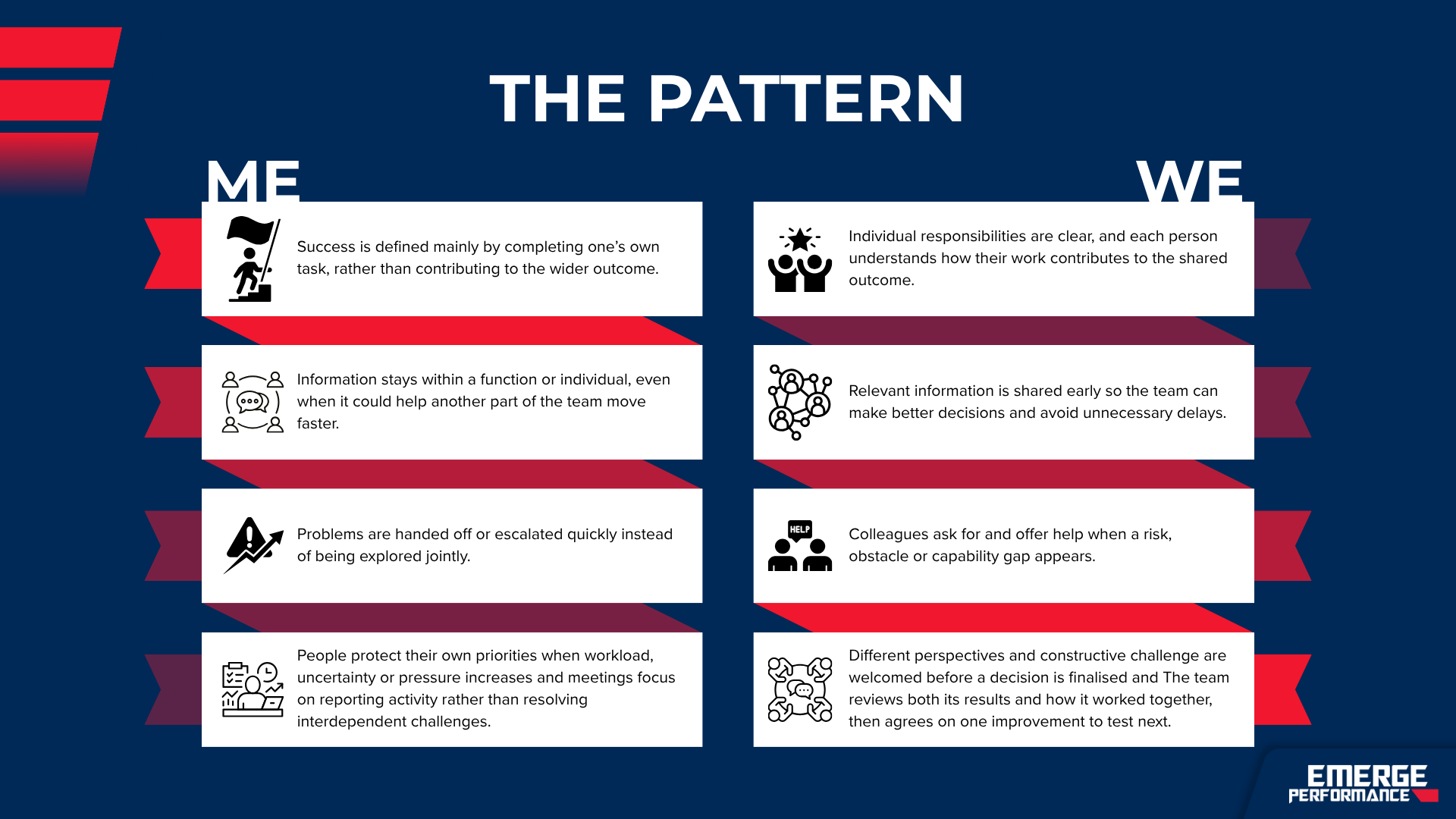
Moving from isolated responsibility to shared purpose and coordinated action.
In a me pattern, people prioritise their own task, function or point of view. Information stays local, problems are handed off and success is defined narrowly. In a we pattern, people remain accountable for their role while connecting it to the shared outcome. They exchange information, ask for support, challenge assumptions and coordinate across boundaries.
This is not about eliminating individuality. Effective teams need clear individual responsibility; the shift ensures that individual contribution serves a common purpose rather than becoming a silo.
The Case: A Pharmaceutical Company at a Crossroads
Pharma P at a glance
Industry: Pharmaceutical Size: Medium-sized firm, 200+ employees
Region: Asia Pacific Years active: 15 years
After 15 years of regional success, Pharma P was preparing to integrate new products into international markets. The global pandemic then introduced economic uncertainty, remote working conditions and greater operational complexity. The leadership team faced unclear roles, limited proactive support and processes that no longer matched the pace of business.
The Intervention: From Diagnosis to Shared Ownership
Emerge Performance designed a six-month intervention beginning with individual psychometric evaluations and team performance diagnostics. This gave the team a shared evidence base rather than relying on assumptions about what was not working.
A two-day workshop focused on cohesion, trust and open communication, followed by six executive coaching sessions. Psychological safety was central: leaders needed to ask for help, offer different views and surface concerns without unnecessary fear of judgement.
What Changed
The intervention extended to more than 20 senior leaders across Pharma P and its sister company, supported by five executive coaches. These results are specific to this engagement and are not a guarantee for other organisations.
The organisation emerged with greater clarity, collaboration and an improved capacity to lead through uncertainty. Continued reflection and reinforcement were needed to sustain progress.
How to Strengthen Organisational Performance
- Clarify the shared outcome and each function’s contribution.
- Make roles, decision rights and information flows visible.
- Create regular opportunities to raise risks, seek help and resolve disagreement early.
- Develop leaders who model curiosity, accountability and mutual support.
- Review both the result and how the team worked together to achieve it.
Why Me Patterns Persist in Capable Organisations
A me pattern is rarely caused by a lack of goodwill. It usually appears when the operating environment rewards local delivery more visibly than shared delivery. A functional leader is measured on a target that belongs to their department, a manager has limited time to understand work outside their remit, and urgent issues are passed to the person with the most expertise. Each choice can feel sensible in isolation. Over time, however, the organisation develops a habit of optimising parts rather than the whole.
This pattern becomes more likely during growth, restructuring, product launches, or uncertainty. Roles change faster than working agreements. Information is held in systems that are not routinely shared. Leaders have fewer informal conversations across functions, especially when teams work remotely or across locations. When pressure rises, people often return to the behaviour that feels safest: protect their own priorities, escalate a problem upward, or wait for another function to act first.
The visible symptoms can look operational: missed handoffs, duplicated work, slow decisions, repeated meetings, or late identification of risk. The underlying issue is relational and systemic. People may not have a common picture of the outcome, understand which trade-offs they can make together, or feel confident that asking for support will be met constructively. The result is not simply a process problem. It is a coordination problem.
Moving from me to we does not mean everyone must agree all the time. It means the team develops a reliable way to bring different expertise into the conversation before it becomes a blockage. Individuals retain clear accountability, while the group takes collective responsibility for the quality of decisions, handoffs, and follow-through. That distinction is what turns collaboration from a vague value into an operating capability.
Signals That a Team Is Stuck in a Me Pattern
Leaders can spot a me pattern by listening to how people describe problems. Phrases such as “that is not our responsibility,” “we were not told,” or “they need to decide first” can signal that boundaries have become barriers. One comment is not a diagnosis; a repeated pattern is. The useful question is not who is at fault, but what in the team’s design makes this response understandable.
Look for patterns, not isolated incidents
- Information arrives too late. Teams discover changes when an upstream decision is already difficult to influence.
- Meetings report rather than resolve. Updates are exchanged, but risks, trade-offs, and decisions are carried to another meeting.
- Ownership is unclear at the edges. Everyone understands their own task, but no one owns the handoff between functions.
- Requests for help are delayed. People work around a problem alone until the cost of delay is greater than the discomfort of asking.
- Escalation replaces conversation. Leaders are asked to arbitrate decisions that peers could resolve with clearer decision rights.
- Success is celebrated locally. Functions meet their own goals while the customer, patient, partner, or internal client experiences friction.
These signals are especially useful because they are observable. A leadership team does not need to begin with a large culture survey to make progress. It can select one recurring cross-functional outcome, map the path work takes, and ask where information, authority, or support gets stuck. That creates a starting point grounded in real work rather than abstract labels.
The Leadership Behaviours That Make We Possible
Culture becomes credible through repeated leadership behaviour. A senior team cannot ask others to work across boundaries while it protects its own functional territory. The shift starts when leaders model the habits they want the organisation to use: explaining the shared outcome, naming interdependencies, inviting challenge, and following through on decisions made together.
1. Frame work around the shared outcome
Leaders can begin meetings by clarifying what the group is trying to accomplish for the organisation, customer, or stakeholder—not only what each function needs to complete. This does not remove functional goals. It makes the connection between those goals visible. A clear frame also changes the quality of questions. Instead of asking, “Has my team finished its part?” leaders ask, “What needs to be true across the system for this outcome to succeed?”
2. Make requests and commitments explicit
Collaboration becomes unreliable when requests are implied. A strong we practice is to state who needs what, by when, and for what decision or outcome. The receiving person or team can then accept, negotiate, or decline the request with the necessary context. This is more respectful than leaving an obligation ambiguous, and it reduces the silent assumptions that cause frustration later.
3. Replace blame with joint inquiry
When work breaks down, the quickest response is often to identify the person or function that missed a step. A more productive response is to investigate the system: What information was available? Which decision right was unclear? What assumption went untested? What made it hard to raise the risk earlier? Joint inquiry does not remove accountability. It makes accountability useful by showing what should change next time.
4. Reward contribution beyond one’s own boundary
Leaders notice what they value. Recognising people who help another function understand a risk, share expertise, or unblock a decision shows that collaborative work counts. Recognition should be specific: name the behaviour, the partner supported, and the difference it made to the shared outcome. This reinforces that we is not a slogan; it is a standard for how work is done.
Build the Operating System for Shared Ownership
Good intentions alone cannot sustain a we culture. Teams need a small set of operating mechanisms that make collaboration easier at the moment it is needed. The aim is not to create more governance. It is to make essential decisions, information, and support visible enough that people can act without waiting for a crisis.
Shared priorities and success measures
Choose a limited number of outcomes that genuinely require more than one function. Describe what success looks like in plain language and agree how the group will know it is moving forward. The measures may include delivery, quality, customer impact, risk, speed, or team health. What matters is that the measures reveal whether the system is working, rather than allowing one function to appear successful while another absorbs the cost.
Decision rights that work in practice
Many teams document who is accountable but leave the rest unclear. A practical decision map identifies who recommends, who decides, who must be consulted before the decision, and who needs to be informed afterward. The map should focus on the few decisions that repeatedly cause delay or escalation. Review it after a live decision: did the right people have enough context, did the decision happen at the right level, and was the rationale communicated?
Rhythms for coordination
Regular meetings should have a defined job. A short operating meeting may surface risks and dependencies. A longer monthly session may examine performance patterns and strategic trade-offs. One-to-one conversations may support coaching and development. When every meeting attempts to do all of these things, none receives enough attention. A clear rhythm helps people know where to take an issue and reduces the temptation to create another meeting whenever uncertainty appears.
Visible handoffs and escalation paths
Work often fails at the moment it crosses a boundary. Teams can improve this by identifying the handoffs that matter most, agreeing what a good handoff includes, and setting an escalation path for exceptions. The useful design question is: if the normal process stops working, who talks to whom first, and how quickly? A direct peer-to-peer route usually resolves more than a chain of copied emails.
These mechanisms are not separate from culture. They are the practical expression of culture. A team that wants more trust makes it safer to ask for help. A team that wants more ownership makes decision rights clear. A team that wants more collaboration makes interdependence visible in its goals and meeting rhythm.
A 90-Day Plan to Move From Me to We
Days 1–30: Create a shared picture
Begin with a defined business outcome that requires coordinated work, such as a product launch, a critical customer journey, a service improvement, or an integration milestone. Ask the leadership group to describe the outcome in one sentence: who benefits, what must change, and how will the group know it is working. This discipline prevents a broad culture discussion from becoming detached from real work.
Next, map the system around that outcome. Identify the functions, leaders, frontline teams, and stakeholders who influence it. Track where decisions, information, and work move from one group to another. The map does not need to be perfect. Its purpose is to make the unseen dependencies discussable. Leaders often discover that a “people issue” is partly an unclear handoff, an invisible approval, or a measure that drives local optimisation.
Agree on a small diagnostic set: what are people experiencing now, what evidence is available, and what questions need direct input? Short interviews, a team session, process observations, and a review of current measures can all help. Make the process psychologically safe by clarifying that the goal is learning and improvement, not finding a person to blame.
Days 31–60: Test new ways of working
Use the findings to establish two or three operating agreements. Examples include rotating meeting facilitation, documenting decisions within twenty-four hours, inviting the affected function before a decision is final, or raising a risk as soon as it cannot be resolved locally. Keep the agreements concrete enough to observe in the next two weeks.
Leaders should practise the behaviours personally. In a meeting, they can ask whose perspective is absent, state the cross-functional trade-off, or invite a dissenting view before closing a decision. After the meeting, they can ask whether the discussion made it easier or harder for others to contribute. Small reflective moments are often more effective than a large declaration of culture because they connect insight directly to the team’s lived experience.
Give the team a way to review its experiments. A fifteen-minute reflection can ask: What helped us coordinate this week? Where did we fall back into a me response? What will we do differently next time? This builds collective learning without creating an additional reporting burden.
Days 61–90: Embed ownership and review evidence
At the end of the first ninety days, review both results and interaction evidence. Did decision time improve? Are people getting information earlier? Have repeated escalations reduced? Do team members report greater clarity about roles and shared priorities? The data need not be elaborate. It should be credible enough to show whether the new agreements are helping.
Decide which practices become part of the standard operating rhythm and which need refinement. Some agreements may be too vague, too heavy, or unnecessary once people have learned a new habit. Assign ownership for maintaining the practices, but avoid locating all responsibility with one coordinator. Shared ownership is reinforced when each leader commits to one behaviour they will continue to model and one dependency they will actively manage.
How to Measure Organisational Performance Without Over-Measuring
Measurement should support learning, not create an extra layer of administration. A useful performance view combines outcome measures with evidence about the way work is being done. Outcome measures might include delivery milestones, quality, revenue, service levels, or customer experience. Process measures might include decision cycle time, rework, backlog age, or the number of issues resolved at the right level. Team measures might include clarity, confidence in raising concerns, or access to the information needed to act.
Use a baseline wherever possible. The question is not whether every metric improves immediately; it is whether the team can see a meaningful direction of travel and understand why. A leadership group might review five measures monthly, then choose one collaboration pattern to explore in more depth. For example, if a launch date slips, the discussion should examine not only the timeline but also when the risk became visible, who had decision authority, and whether the handoff standard was clear.
Qualitative evidence matters too. Short prompts can reveal what a dashboard cannot: “Where did we coordinate well this month?” “What made it hard to ask for help?” “Which decision felt clear, and which felt confusing?” The answers become especially valuable when compared over time. They show whether the team is building the confidence and discipline that allow results to be sustained.
Applying Me to We During Change and Uncertainty
Change intensifies the tension between me and we. When plans shift, people naturally seek certainty in their own role, expertise, or team. That response is understandable, but it can make the wider organisation slower to adapt. A we approach helps leaders hold two responsibilities at once: protect essential local delivery and remain open to the information needed to adjust the shared plan.
Communication during change should therefore be both clear and dialogic. Leaders need to explain what is known, what is still uncertain, which decisions have been made, and where input is still needed. They also need channels through which people can surface customer signals, operational risks, and unintended consequences. Saying “we are all in this together” is insufficient if people do not know how their observations will affect the next decision.
In regulated or high-stakes industries, the need for coordination is even sharper. Quality, compliance, commercial priorities, and people considerations may each be legitimate but competing demands. The goal is not to minimise healthy tension. It is to bring that tension into the right forum early enough that leaders can make a deliberate trade-off. When teams learn to do this, uncertainty becomes less of a reason to retreat into silos and more of a reason to strengthen their shared operating discipline.
Common Mistakes When Building a We Culture
- Treating collaboration as agreement. Teams need respectful challenge and clear decisions, not perpetual consensus.
- Removing individual accountability. Shared ownership works best when each person’s role and commitments are visible.
- Launching too many values or behaviours at once. Choose a few practices that people can apply in real work and review together.
- Using workshops as a substitute for operating change. A workshop can create insight; meeting rhythms, decision rights, and handoffs turn insight into habit.
- Expecting trust without changing conditions. People are more likely to speak up when leaders respond constructively and decisions are documented fairly.
- Measuring only the final outcome. Teams also need evidence about the collaboration patterns that produce or undermine that outcome.
The most sustainable approach is usually modest and persistent. Start with one important outcome, one recurring coordination challenge, and a few practices that make interdependence easier to manage. As the team sees progress, it can apply the same approach to other parts of the organisation.
Conversations That Help Teams Move From Me to We
Shared ownership is built in the quality of everyday conversations. Leaders do not need a perfect script, but they do need questions that shift attention from defending a position to understanding the whole. The most useful questions connect the immediate issue to the wider outcome and give people permission to name what is difficult.
Before a decision
Ask: What outcome are we protecting together? This question brings a fragmented discussion back to purpose. Then ask, Whose expertise or perspective is missing? The goal is not to involve everyone in every choice; it is to make sure the people who will carry the consequence have an appropriate voice before a decision becomes fixed. Finally, ask, What are the trade-offs, and who has the authority to make them? Clear trade-offs reduce the false expectation that every priority can be maximised at once.
When a handoff breaks down
Ask: Where did the work become unclear or slow? Focus on the point of transfer rather than beginning with an assumption about the people involved. Follow with, What did the receiving team need that it did not have? and What will a good handoff include next time? These questions turn an irritating incident into a practical agreement. They also help teams distinguish a one-off exception from a recurring design issue.
When tension or disagreement appears
Ask: What are we each seeing that the others may not see? Different functions often hold different, valid information about the same situation. Sales may see customer urgency, operations may see capacity constraints, finance may see risk, and people leaders may see the impact on workload. A we culture makes room for those perspectives without assuming that any one of them is the complete answer.
Then ask, What would a responsible decision look like for the whole system? This shifts the conversation away from winning an argument. It invites the group to consider the effect of a decision across functions, stakeholders, and time horizons. The leader’s role is to keep the discussion respectful, ensure the decision right is clear, and state the next step before the group leaves the room.
After an important outcome
Ask: What helped us work well together? Where did we make coordination harder than it needed to be? What will we repeat, stop, or adjust? A short after-action review helps teams learn before memories fade. It should include both successes and friction. If a team only reviews failures, reflection can feel punitive; if it only celebrates results, it loses the chance to strengthen the practices that made success possible.
Over time, these conversations become part of the team’s normal language. People learn that raising a dependency is not a sign of weakness, asking for a different view is not a delay tactic, and acknowledging a trade-off is not an admission of failure. That is how a leadership group creates the conditions in which a we mindset can hold even when deadlines and pressure increase.
Sustaining the Shift: From Initiative to Everyday Practice
The first improvements in collaboration often appear when a team has focused attention, a clear challenge, and external support. The more difficult task is sustaining the shift once the workshop has ended, a coach is no longer in the room, or the next urgent priority arrives. A we culture becomes durable when the behaviours are woven into normal management practice rather than treated as a separate initiative.
Start by deciding where the team will revisit its operating agreements. For many leadership groups, the best place is an existing business rhythm: a weekly operating meeting, a monthly performance review, a quarterly planning session, or a post-project review. Add a short, consistent question to that rhythm. For example: What dependency needs more attention this period? Where did we make a decision without enough cross-functional context? Which behaviour helped another team succeed? Repeated questions shape attention, and attention shapes habits.
Make shared ownership visible in leadership routines
Leaders can reinforce the shift through the routines they already control. When setting objectives, they can include at least one cross-functional outcome alongside individual or functional goals. When reviewing performance, they can ask how a person contributed to the wider system as well as what they personally delivered. When planning resources, they can discuss the effect of a local choice on other teams before the choice is final. None of these actions requires a new programme; each makes the existing system more coherent.
It also helps to name the boundaries that still matter. Shared ownership is not an invitation to blur every role or involve every stakeholder in every decision. Teams work better when people understand where they can act independently, where consultation is essential, and where the group must make a deliberate trade-off together. The aim is appropriate connection, not permanent consensus.
Develop managers as multipliers of the culture
Middle managers are especially important because they translate senior intent into the daily experience of employees. They set the tone in one-to-ones, decide what gets escalated, and influence whether people see another function as a partner or an obstacle. Support managers to practise clear contracting, curious questioning, timely feedback, and constructive challenge. Give them opportunities to compare real cases with peers: a difficult handoff, a competing-priority discussion, or a decision that had to be revisited. Peer learning turns abstract leadership expectations into usable judgement.
Managers also need permission to surface constraints upward. A we culture cannot depend on individual heroics to solve structural problems. If targets conflict, capacity is insufficient, or a decision right is genuinely unclear, managers should be able to bring evidence to senior leaders without being labelled resistant. Senior leaders then have a responsibility to respond visibly: clarify the priority, adjust the system, or explain the trade-off. This closes the loop between what people experience and what the organisation learns.
Use setbacks as learning opportunities
Every team will revert to a me response at times, particularly under pressure. The test is not whether the team avoids every setback. It is whether it can notice the pattern quickly, talk about it without defensiveness, and repair the working relationship. A missed handoff, a late escalation, or a tense decision can become useful data when the team asks what made the response likely and what agreement would make a better response easier next time.
This approach keeps accountability intact. The person responsible for an action still owns their commitment, while the team learns whether the conditions around that commitment supported success. In this way, performance conversations become less about protecting reputation and more about improving the system. Over time, people become more willing to bring incomplete information, early warnings, and alternative views into the open—the very inputs a complex organisation needs in order to adapt.
The enduring value of the me to we shift is not a single metric or workshop outcome. It is the organisation’s growing ability to see interdependence clearly and act on it. When leaders connect purpose, accountability, information, and learning, they give teams a better chance of delivering today while becoming more capable of handling tomorrow’s uncertainty.
Key Takeaways
- The Me vs We shift connects individual accountability to a shared outcome.
- Performance depends on results as well as the clarity, collaboration and decision quality that sustain them.
- Psychological safety and proactive support help teams navigate uncertainty without retreating into silos.
Frequently Asked Questions
What is organisational performance?
Organisational performance is how well an organisation achieves its goals while maintaining the capabilities needed to sustain those results. It includes outcomes such as growth, quality, service, innovation, or delivery, as well as the leadership, people, systems, and culture that make those outcomes repeatable. A useful performance conversation therefore asks both “What did we achieve?” and “How did we work together to achieve it?”
What is the Me vs We paradigm?
The Me vs We paradigm distinguishes a pattern of acting primarily from individual or functional self-interest from a pattern of acting with a shared-team perspective. A healthy we approach does not ask people to abandon their expertise or responsibilities. It connects each person’s responsibility to a common outcome, making dependencies, trade-offs, and opportunities for mutual support visible.
Why is organisational performance important?
It shows whether strategy is becoming meaningful results and helps leaders decide where to focus resources. Strong organisational performance is not only about a single successful quarter or project. It is about building the clarity, decision quality, collaboration, and adaptability that allow teams to perform when conditions change. This makes performance a leadership and operating-system question as well as a financial one.
How does saying Me or We change the psychological response?
Me can highlight personal responsibility and an individual point of view. We can highlight belonging, shared identity, and interdependence. Neither word is automatically better in every situation. Leaders can use we to invite collective ownership of a challenge, then use clear language about who owns the next action. The strongest teams can move fluidly between individual accountability and collective responsibility.
How can a leader create shared ownership without becoming controlling?
Start by clarifying the outcome, boundaries, decision rights, and what good evidence looks like. Then give people space to decide within those boundaries and ask for support early. Control increases when leaders hold all context and approve every choice. Shared ownership increases when leaders share context, make trade-offs explicit, and coach people to use sound judgement. Regular review replaces micromanagement with learning.
What is the difference between teamwork and cross-functional collaboration?
Teamwork often refers to how a defined group works together. Cross-functional collaboration includes the relationships and handoffs between groups with different goals, expertise, and measures of success. It requires more deliberate coordination because no single manager may own the whole outcome. The Me to We shift is particularly useful here because it prompts people to look beyond their function and take responsibility for the connections between teams.
Can a we culture work when people are remote or across locations?
Yes, but it needs explicit design. Remote and distributed teams benefit from clear meeting purposes, written decisions, predictable communication channels, fair participation practices, and visible handoffs. Informal relationship-building still matters, but it cannot be the only way information travels. Leaders should create moments for people to clarify assumptions, raise risks, and understand how work in one location affects another.
How long does it take to change from me to we?
There is no fixed timeline. A team can make practical improvements in the first few weeks when it focuses on a real coordination challenge. Sustainable change takes longer because it requires new habits to be tested, reinforced, and used under pressure. The most reliable approach is to establish a small number of agreements, review evidence regularly, and build the practices into normal decision-making and management rhythms.
Strengthen organisational performance
Build the leadership, collaboration and shared ownership that help teams deliver through uncertainty and change.
9 thoughts on ““Me vs We” A Case Study on Organization Performance”
Comments are closed.
You’ve really highlighted the important parts—well done!
This post provided some really helpful insights—well done!
You’ve tackled this subject really well—good job!
You’ve answered a lot of questions I had—thank you.
This is an excellent post, I learned so much from it.
You’ve really helped me understand this topic better.
I enjoyed reading this, you’ve covered everything so well.
This is such a valuable post, thanks for putting it together.
This article is a real gem—thank you for sharing!