 In a fast-moving corporate environment, success is not only about finishing a list of tasks. Teams also need to create value that moves the business forward: solving problems, improving a customer experience, making better decisions and adapting when conditions change.
This challenge becomes even more pressing when businesses face stiff competition, market shifts or internal resistance to change. The anonymised Thai-company case below, drawn from an Emerge Performance coach’s experience, illustrates how coaching can bridge this gap by aligning team performance with business goals, fostering innovation and strengthening leadership.
The Challenge: When Task Completion Stops Being Enough
Task-oriented systems can be useful. They create consistency, clarify responsibility and make delivery visible. The limitation appears when task completion becomes the definition of success. Teams can be highly active without asking whether their work is still the right contribution to make.
A value-led team asks a wider question: what outcome does the business, customer or organisation need from us? This does not dismiss discipline or delivery. It connects them to a meaningful result.
How Team Dynamics Work
Team dynamics are the patterns created by repeated interactions: how people communicate, make decisions, share information, handle disagreement, distribute work and respond when pressure rises. They are influenced by role clarity, leadership behaviour, workload, power differences, working agreements and the level of trust within the team.
A team does not need identical personalities or complete harmony to work well. It needs a shared purpose, clear expectations and a constructive way to resolve tension. When these conditions are weak, teams can become dependent on a few voices, avoid difficult conversations or lose sight of what matters most.
A Case Study: A Thai Company at a Turning Point
Real Insight from Emerge Performance’s Coach Experience
A well-established Thai company had long relied on a “task-completion equals success” mindset. While the system ensured predictability and operational order, it also limited innovation and adaptability – two capabilities the organisation needed to compete in a changing market.
Leaders wanted teams to connect day-to-day work more directly to business goals. Yet senior employees, deeply familiar with the task-based culture, were cautious about a value-driven approach. Fear of the unknown and concern about higher performance expectations created low morale and heightened anxiety across teams.
Breaking the Mold: A Coaching Intervention
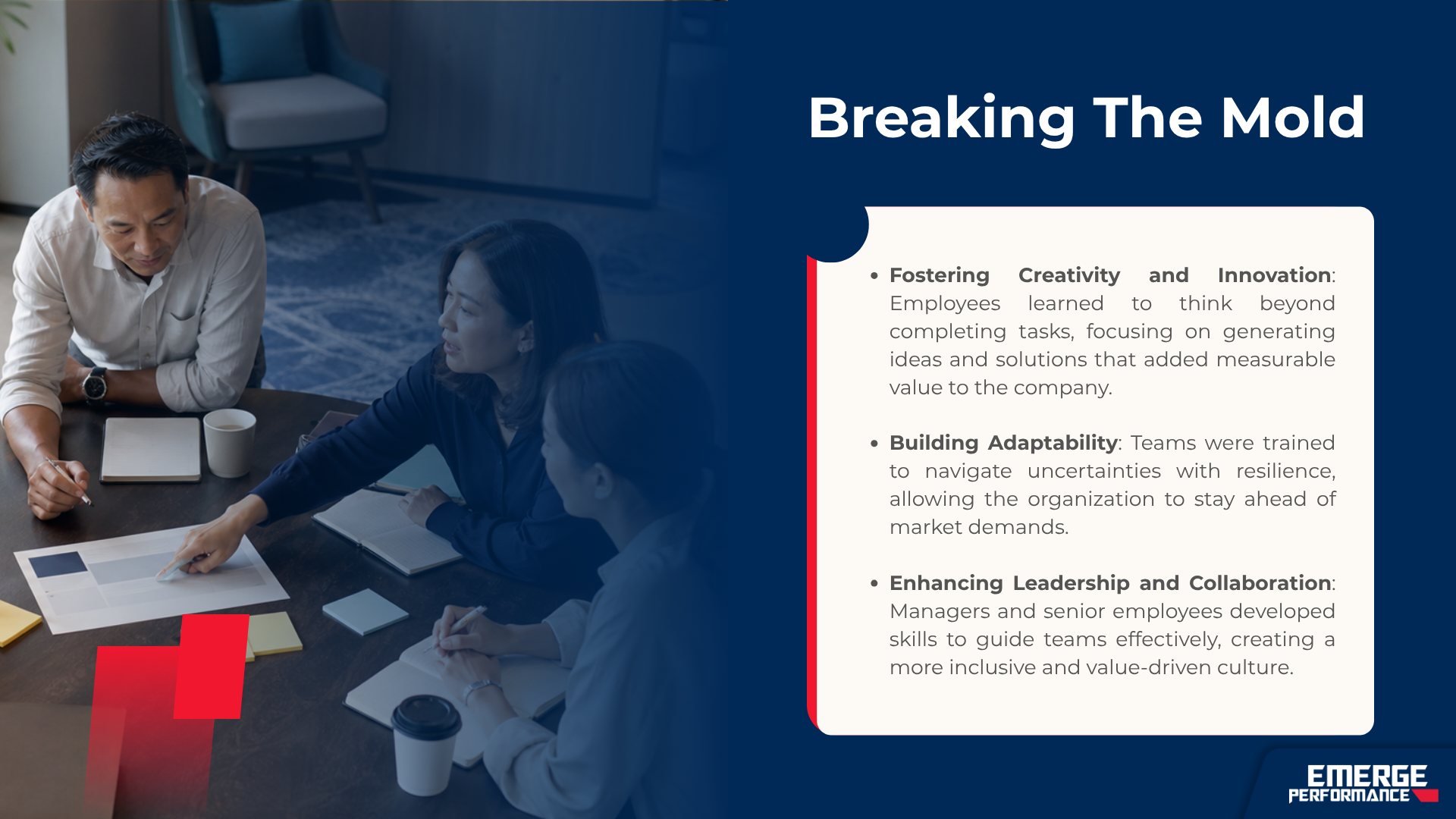
Recognising the need for change, the organisation adopted a tailored coaching intervention to realign team effort with business goals. The programme did not treat resistance as failure; it created structured conversations about what the organisation needed next and how people could contribute to it.
Fostering creativity and innovation
Coaching encouraged teams to look beyond completing activities and ask where they could generate measurable value. The emphasis was on surfacing ideas, questioning inefficient routines and identifying relevant improvements.
Building adaptability
Teams practised working with uncertainty rather than waiting for every answer to be clear. The aim was to build confidence in testing, learning and adjusting when priorities or market conditions changed.
Strengthening leadership and collaboration
Managers and senior employees were supported to guide the shift in everyday interactions: clarifying priorities, inviting input and helping colleagues connect their work to shared outcomes.
Tackling Resistance to Change
Resistance often signals that people do not yet see the purpose, the path or their place in the change. Three practices were particularly important in this engagement:
Make the purpose visible
Explain the long-term business reason for changing how success is defined. A clear connection between team goals and organisational objectives helps people understand why the shift matters.
Lead with empathy and honest dialogue
Create room for concerns about workload, status, capability and uncertainty. Open conversations help leaders hear what sits beneath resistance and respond without dismissing experience.
Build a supportive environment for experimentation
Give teams permission to test small improvements, learn from what does not work and refine their approach. This kind of safety matters when people are being asked to move beyond familiar routines.
The Transformation
The impact of the coaching programme was a gradual but meaningful shift in how teams defined success. Rather than focusing only on completing assigned work, teams began to connect their contributions with business value, the organisation’s wider vision and the needs of the market.
As leaders practised clearer communication, empathy and support for experimentation, teams had more room to generate ideas, adapt to changing demands and collaborate across established boundaries. The intended outcome was not simply higher activity; it was stronger alignment, more confident problem-solving and a culture better able to evolve.
Practical Ways to Improve Team Dynamics
Leaders can improve team dynamics by changing the conditions in which people work together. Start with these five practical moves:
- Clarify the shared outcome, roles and decision rights. Ambiguity creates duplicated work and avoidable tension.
- Make communication regular and two-way. Surface progress, risks, ideas and concerns before they become larger issues.
- Create psychological safety through leadership behaviour. Invite different perspectives and respond constructively when someone raises a problem.
- Agree on accountability and conflict practices. Address disagreement early, respectfully and with attention to the work rather than the person.
- Review the team’s ways of working. Ask what is helping, what is getting in the way and what small experiment the team will test next.
What Leaders Can Learn
In this engagement, coaching created a way to surface concerns, reframe success and establish a more value-led conversation. The team began moving from a task-completion lens towards shared contribution to business outcomes. Sustainable change came from reinforcing the new conversation in meetings, priorities and leadership behaviour.
- Link performance to value: make the desired business outcome visible, not only the activity required to get there.
- Treat experienced employees as partners: their knowledge and concerns can improve the change process.
- Coach managers to shape the context: day-to-day questions, feedback and decisions determine whether a new mindset becomes real.
- Reinforce the shift over time: recognition, team reviews and priorities should reflect the behaviour the organisation wants more of.
Key Takeaways
- A reliable task system is not automatically a value-creating team culture.
- Coaching can help teams connect daily work with business priorities and shared outcomes.
- Leaders need clarity, empathy and safe experimentation to work productively with resistance.
- Transformational leadership is built in repeated conversations, not only in transformation plans.
Frequently Asked Questions
What are team dynamics?
Team dynamics are the patterns of interaction within a team: how people communicate, make decisions, handle disagreement, share responsibility and respond to pressure.
How can coaching improve team performance?
Coaching helps teams notice unhelpful patterns, clarify a shared purpose and practise more productive conversations. Its value comes from turning insight into repeatable behaviour in real work.
Why do teams resist change?
Resistance can arise when people are unclear about the reason for change, worry about increased expectations or feel their expertise is being overlooked. Empathy, clarity and small supported experiments make transition more workable.
Who is The Enterprise Coach Programme for?
The programme is intended for leaders, internal coaches and external coaches who want practical tools to lead change, support team dynamics and contribute to organisational transformation.
How do team dynamics work?
Team dynamics work through repeated patterns of interaction. Every day, teams form expectations about who speaks, how decisions are made, whether it is safe to challenge an idea, how work is shared and what happens when a problem appears. Those patterns shape trust, collaboration, learning and performance over time.
Are team dynamics fixed?
No. Team dynamics can change as team membership, leadership, goals, workload and working conditions change. They can also improve deliberately when a team clarifies its purpose and roles, practises better conversations and reviews how it works together.
How do you improve team dynamics?
Improve team dynamics by creating clarity, trust and regular reflection. Set shared goals and roles, encourage open communication, make it safe to raise concerns, address conflict early and agree on accountability. Then test one practical improvement at a time.
Take the Next Step in Transforming Your Team
Ready to put these insights into practice?
Explore The Team Coach programme to strengthen your team coaching skills, navigate complex team dynamics and move closer to earning your ICF Advanced Certification in Team Coaching. If your business faces similar hurdles, The Enterprise Coach Programme offers a structured solution.
This programme equips you to:
- Navigate resistance to change effectively.
- Cultivate high-performing, value-oriented teams.
- Align team objectives with broader business goals for measurable success.
Explore The Team CoachExplore The Enterprise CoachContact an Associate