
Train Toward Your ICF ACC Credential

The Performance Coach Level 1 is an ICF-accredited coach-training programme that builds real coaching confidence through hands-on practice, mentor support, and a clear pathway to your ACC credential—typically completed in 6–8 months.

3D illustration of an online coaching session with DISCO LMS and ConveraLab for TPC Level 1
icfLevel 1 Accredited Coach
Training Programme
60+ hoursCoach education
10+ hoursMentor coaching
5 sessionsObserved coaching practice
6–8 monthsTraining duration

Knowing coaching is not the same as being able to coach.

The Performance Coach (TPC) Level 1 goes beyond coaching theory. This ICF-accredited coach training programme helps you develop practical coaching skills through real practice, feedback and reflection, so you can coach with greater confidence in real conversations.

Explore how you’ll learn

Aspiring Professional Coaches

You want to build practical coaching skills and work towards your ICF ACC credential.

Leaders & Managers

You want to use coaching skills to lead better conversations, develop people and strengthen your leadership.

HR & L&D Professionals

You want practical, ICF-aligned coaching skills you can apply to people and leadership development in your organisation.

Professionals Exploring Coaching

You’re considering coaching as a new career, an additional professional skill, or the next step in your development.

Coaching Skills You’ll Develop in TPC Level 1

By the end of the programme, you’ll be able to:

Lead a Complete Coaching Conversation

Structure a coaching conversation from opening to meaningful action.

Build Trust & Psychological Safety

Create the conditions for open, honest coaching conversations.

Listen Beyond the Words

Notice what’s said, unsaid and emerging in the conversation.

Ask Questions That Deepen Awareness

Use thoughtful questions to help people reflect and discover new perspectives.

Coach Real-World Situations

Apply your coaching skills with confidence across different conversations and challenges.

Coach in Line with ICF Core Competencies

Develop your coaching practice around ICF standards.

Hear from our graduates

Your path to ICF ACC

Your pathway to the ICF ACC Credential: complete TPC Level 1, build your coaching experience, then apply to ICF for your ACC credential.

1

Complete ICF Level 1 Coach Training

Complete TPC Level 1 with 60+ coach education hours, 10 mentor coaching hours and a performance evaluation.

2

Complete 100 Hours of Coaching Experience

Build 100 hours of coaching experience through real client coaching and continued practice.

3

Apply & Pass the 60 Question ICF ACC Exam

Submit your ICF ACC application and complete the 60-question ACC Exam as part of the credentialing process.

4

Earn the ICF ACC Credential

Once all ICF ACC requirements are met, you can earn the Associate Certified Coach (ACC) credential.

Explore how you’ll learn

Note: The ACC credential is awarded by the International Coaching Federation (ICF). Completing TPC Level 1 supports the education and mentor coaching requirements but does not itself award the ACC credential.

How you’ll learn

Coaching is learned through practice.

Our experience is a continuous cycle of learning, practice, feedback, reflection and real-world application.

LearnLive interactive sessions
PractisePeer coaching and ConveraLab scenarios
Be observedFive observed coaching sessions
Receive feedbackMentor coaching and supervision
ReflectJournaling and self-awareness
ApplyReal conversations in real situations

What makes TPC Level 1 different?

More than a certification. A real coaching experience.

Practice is built into the programme

Live practice, observed sessions, feedback and reflection are part of the learning journey—not optional extras.

You don’t practise alone

Mentor coaching, supervision, peer coaching and The Coaching Village provide ongoing support.

Grounded in human performance

Insights from performance psychology, leadership and high-performance environments deepen your practice.

Practice beyond the classroom

ConveraLab offers more realistic coaching practice and personalised feedback between live sessions.

Programme brochure

Want the full programme details?

The brochure-download form will be connected here after its final fields and delivery method are confirmed.

Speak to an advisor in the meantime

Programme modules

What you’ll explore along the way.

01 — Introduction to coaching

Discover what makes coaching different from giving advice and build your foundation in coaching ethics and ICF competencies.

02 — Principles of human performance

Explore the behavioural and performance foundations that inform meaningful coaching conversations.

03 — Unlocking effective agreements & contracting

Learn how to establish clarity, focus and shared responsibility in coaching relationships.

Live online cohorts

Find a cohort that fits your schedule.

Choose the language and dates that work for you. Sessions are delivered live online, with flexible support if you miss a class.

What’s included

60+ education hours
10 mentor coaching hours
5 observed coaching sessions
Performance evaluation
Group supervision
Peer practice
ConveraLab access
Lifetime Coaching Village access

Cohort dates, fees and delivery language will be confirmed before publishing.

Frequently asked questions

Questions people ask before joining.

What is The Performance Coach Level 1?

It is an ICF-accredited coach-training programme designed to develop practical coaching skills through live learning, practice, feedback and mentor coaching.

Does completing TPC Level 1 make me an ICF ACC coach?

No. It supports the education and mentor-coaching elements of the pathway; ICF awards ACC only after all its requirements are met.

Is this suitable for leaders and HR professionals?

Yes. The programme is designed for people who want to use coaching to develop others and lead more effective conversations.

Do I need coaching experience before joining?

No prior formal coaching experience is required. The learning experience builds from core foundations into supervised practice.

How much real coaching practice will I get?

You will practise through live learning, peer coaching, observed sessions and realistic conversations supported by feedback.

About TPC Level 1

Build practical coaching skills that travel into real work.

The Performance Coach Level 1 by Emerge Performance is designed for leaders, HR professionals and developing coaches who want to strengthen how they listen, question, develop people and support performance.

HomeAll InsightsBlogNavigating the Digital Revolution the Mindful Way

Navigating the Digital Revolution the Mindful Way

At the recently concluded InnovFest Unbound conference in May, a group of key players in the online commerce industry were discussing how to navigate the current digital landscape amidst the buzz of big data. Nick Nash, Group President of Garena, opined that while we now have access to immense data and information, they are useless unless they help us make better decisions. For example, Fitbit devices are branded as wearable tools to help us develop
a healthier lifestyle by tracking the number of steps we take, our heart rate, how much we sleep, etc. In short, they collect a lot of data. The question
is whether the data collected by Fitbit devices actually makes a difference to our well-being.

With the rise of the internet of things (IOT) and the quantified self (QS), the volume of information streaming in will continue to rise unabated and at
exponential rates. Our ability to process the influx of data coming from all spheres of our lives will be a function of how well we can pay attention
to the right things at the right time. This is a key attribute of mindfulness. Think of mindfulness as the way you manage your attention like a spotlight.
As we navigate through this digital revolution, mindfulness will become increasingly vital to our well-being, decision-making and performance. Why?
Because what we pay attention to and how we maintain our focus amidst an avalanche of data influences the type of information we choose to examine,
colours our perception and impacts the decisions we make.

The average attention span in 2015 was 8.25 seconds, down from 12 seconds in 2000.
For comparison sake, the average attention span of a gold fish is actually better at 9 seconds. These statistics are suggestive of the fact that our ability to pay attention is degrading, while the inflow of information we process is increasing. We are constantly distracted by anything and everything, glued to our smartphones. Being constantly “on”, it’s no wonder that many working professionals are disengaged, overwhelmed and burning out. Linda Stone, a thought leader in this field, expands on this by calling it an epidemic of continuous partial attention (CPA) – defined as the process of paying simultaneous attention to a number of sources, but at a superficial level.
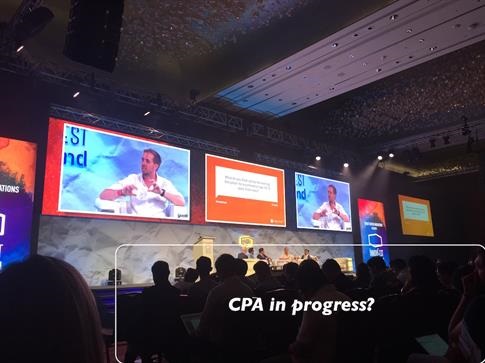
As the panel discussion unfolded at InnovFest Unbound, many in the conference room were busy snapping photographs, posting on Facebook (me included), tweeting, searching for the relevant hashtags, micro-blogging
and checking out the rest of the conference’s schedule. What were we really paying attention to? Many things, but not really anything.

We can manage CPA by practicing mindfulness – in other words, by choosing what and where we focus our attention. The practice itself is not complex, but
what is important is to practice it with consistency and regularity. Here’s a simple way to practice anytime, anywhere: use your breath to anchor your
attention. See if you can stay in touch with the full cycle of your breath, in and out, as best as you can. If you wander from the anchor, and upon
realizing the drift, choose deliberately to bring your attention back to your breath. Your mind will be sure to wander, so the shift back to the breath
is the key, however many times it takes – these are the valuable reps that over time will strengthen your attentional muscle as you work out at your
own mind gym.

The digital revolution holds great promise, but it does not necessarily guarantee the improvement of our well-being. When you become conscious of your
own CPA tendencies, mindless online surfing and Facebooking, come back to your breath, reset your attention and make a choice. If we can live mindfully,
we can make better decisions and take better care of ourselves and those around us.

If you’re keen to find out more about mindfulness join our MBSR – Mindfulness 8 weeks training program. Our next run starts on 22 Jul 2016.  

This article is also published on PurelyB.com, your go-to guide for leading a sustainable healthy lifestyle in Asia.


×
Limited Promotion
Receive up to
50% Discount
on The Performance Coach programs

Explore The Performance Coach (TPC), an ICF Level 1 & Level 2 pathway designed to help coaches build a strong foundation and deepen their executive coaching practice.


View TPC Level 1


View TPC Level 2


×
Limited 1-for-1 Promotion
Enrol together
1-for-1 Promotion
One paid enrolment gives you two participant places

Explore The Team Coach (TTC), an
ICF-accredited team coaching pathway
designed to help coaches develop the skills to coach high-performing teams.


View TTC Programme