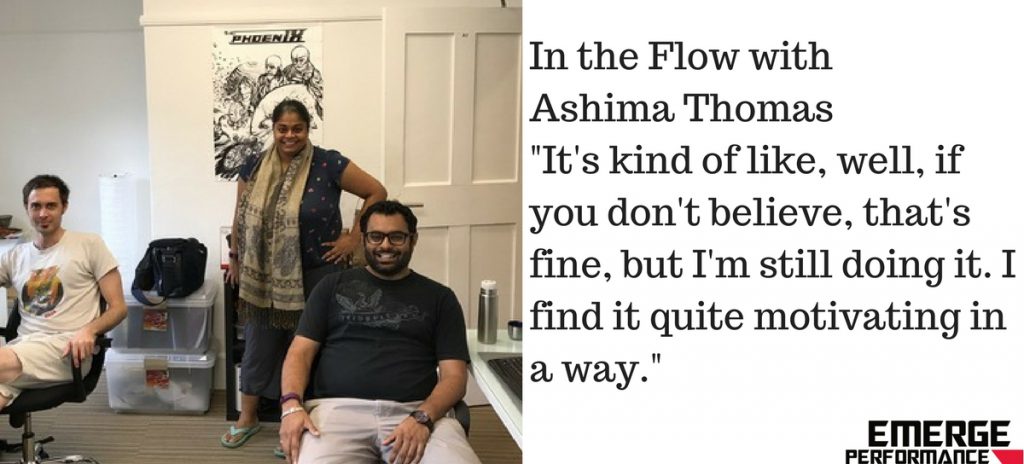
This month we sit down with Ashima Thomas. Ashima is a storyteller and is at the forefront of using virtual reality (VR) technology to tell incredible
tales. Let’s see what we can learn from her journey to the edges of the mainstream universe.
Hi Ashima. Could you tell me more about your background and what you used to do previously?
I used to be a journalist, and I feel in a way that I still am, but not in the traditional sense. I worked in TV – I was in TV news for about 10 years as a producer and deputy news editor. After doing that for 10 years, I left to join a new digital storytelling platform called Our Better World. Then I decided to start my own company. I still work with Our Better World, but I also have the capacity to work with other people and do other things. My company is called Warrior9 and we celebrated three years in January.
Tell me about Warrior9.
Warrior9 was originally me and two partners. We started it because we wanted to make a short film and having a company structure behind that made the administration easier. So we made the short film just as a passion project and really enjoyed it. At the same time, I was continuing the work I had already been doing, except through my own company.
But then a shift happened because I think I realised that we have this company, so let’s build the company. I had absolutely no business experience. I hadn’t studied business, so I didn’t really know what that meant. So I started to do the work to figure out what does that mean, what is our product going to be. Of course, I’m a storyteller and my partner is a storyteller, so we knew it would be some kind of storytelling product. That’s when we started making content on commission.
Right from the beginning, there was this feeling of wanting to grow the business. We spent a couple years doing commissioned work and creating stories for others. We made an effort to stick to the kind of stories we love, so we didn’t do any traditional corporate work like corporate videos; we avoided this as much as possible.
We really committed to telling stories. It was kind of a hard path because all the money is in events, event coverage, corporate work, weddings, that sort of thing. But that wasn’t our passion. And I felt that since I had this business now, I should do the things I love.
You want to make your own choices.
Yes, exactly. It’s a hard path because I think being a creative business is different to any other kind of business because the outcomes are tangible, but they’re also subjective. You may see one thing, another person may see something else; they may not like it, they might love it. There’s all this extra emotional stuff wrapped up in a creative business. This decision to stick to doing stories we love and believe in is hard because the money is not there. The money is in the corporate work and event work.
You mention that you love stories. Tell me more about that.
I think because of my journalistic background, I was always focused on current affairs and issues and communicating those kinds of concepts. When I moved to Our Better World, we really focused on inspirational stories. They would always be stories about someone doing some kind of good, working at the grassroots level, working with marginalised communities, etc.
We worked on empowerment. That’s how I describe it to people: stories about empowerment. Something that can empower you as a viewer after you watch it – whether it’s a story about someone who is doing something good or even a fictional story that makes you think – and you feel that your thinking has changed a bit. Those are the stories that I really love: doing something that has some kind of impact.
So those are the stories that you love – the ones that have impact, that have an emotional aspect?
Definitely emotional. It’s the ability to move someone, which you can rarely do with facts. I think that after being in journalism for 10 years, I felt like I was just telling people stuff; it was very factual. So I wanted to take that to the next level and try to move people.
So you have embarked upon this road less travelled and chosen to express your creative side and tell the stories that you love despite the other options offering greater commercial potential. Tell me about the fire that’s fuelling this direction.
It’s interesting – I don’t know where it comes from. I suppose it’s about impact. Our tagline is “Changing the world frame by frame”. It sounds really lofty – changing the world – but I really feel that this is ultimately what we want to do. To make some kind of change.
When you look at our body of work, we haven’t really functioned in the mainstream. We’ve been on the edges of mainstream in terms of the types of stories that we like to do. The communities that we’ve worked with have generally been marginalised communities. The issues are not mainstream issues.
Now as we move into VR, it’s also not mainstream. We’ve always had this desire to work on the edges and make it mainstream. Even with VR, our approach has been to create something that is mainstream that people will love en masse to allow them to see the potential of this technology and how it can make their lives better.
I hadn’t really realised that until recently because we hadn’t been able to put our finger on what makes us keep wanting to take on these difficult projects instead of the easy ones. And I think it is that feeling of why do something that other people are doing when we have the resources and brainpower to do something different. Yes, it’s tougher, but that makes it worthwhile.
It’s one of those things that you just know because it’s in you. Looking back, I think we chose our tagline for a reason. But I feel like it’s only now, after three years, that we can really define it. I really get what it actually means to me now. I feel that sometimes you know something only on a surface level, but then you live it and only then do you really understand it.
So you didn’t immediately have absolute clarity on this is who I am and this is what I want to do. Instead, it unveiled itself slowly, frame by frame.
Yes! I always feel that your vision of your end goal is always quite murky, for me at least. I know there are people who say that their end goal is super clear to them, but to me it is almost like I can’t fully see it, but I know that it is big and that I am on that road. And if I veer off, I will feel it and know that I need to get back on that road, but I can’t define exactly what it is.
So you have embraced new technology and change, but at the same time you are anchored to something that doesn’t change, which is your vision. This is reflected in your journey to play at the edges and explore VR technology. Could you tell me more about this?
We started with a project that was originally conceptualised as a 90-minute TV pilot. A science fiction show. As we shopped it around, people told us that no one is going to pick up some random company’s show and fund it. So we asked ourselves, what’s the next best thing we can do. What about doing an animated web series, for example. So we started to shop it around as a web series.
Then we met a company that had just done a project in VR. It is still super early days for VR. They showed us what they did. Everyone’s first VR experience depends on what the content is, but it is generally something completely new. Imagine trying something where you can’t even compare it to anything. For me, the first piece of VR content I watched was mind-blowing. I thought, let’s do the show like this.
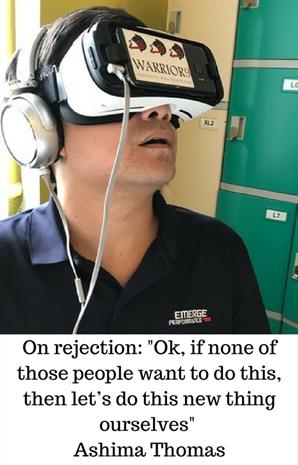
So it was a combination of meeting the right people at the right time, having the right mindset, having the appetite for risk, and also that feeling that after having been shot down by so many people, we really believed that our story was worth making. So we thought, ok, if none of those people want to do this, then let’s do this new thing ourselves.
It sounds like it has been an up and down journey for you. What has helped you navigate the highs and lows?
It’s really not easy. I think you just need to decide how you’re going to deal with the low points. The rollercoaster can be a daily thing. You can go from the biggest high because you just had a conversation with someone who loves what you’re doing to the biggest low because someone has rejected something that you poured your heart into.
It used to be that when I was at a low point, I would be quite discouraged. But what’s happened now is that after realising that we’re on this mission to work on the edges of mainstream and expand the definition of what is mainstream, those low points now actually fuel the fire. I made this big mind shift. It’s kind of like, well, if you don’t believe, that’s fine, but I’m still doing it. I find it quite motivating in a way.
If you turn the rejection around, it becomes your fuel and motivation. Even a validation.
I keep telling myself that all new inventions were things that people were pioneering, so there were a lot of naysayers and people who would ask why are you doing that, it’s too difficult. The thing I hear a lot is that it’s too difficult. And I mean, obviously it is, right? Otherwise, if it’s easy, what’s the point! It’s all connected: this feeling of wanting to push the boundaries means that it has to be difficult.
I want to come back to this idea that something switched in you, taking you from that low point and turning it into your fuel. What do you think resulted in this switch?
What we have currently is a proof of concept for our show. Our show is nine episodes and what we have is a teaser, which we’re showing people in VR. When we finished the teaser in May 2016, we went on the road to show it to people at conferences and events. It was seeing their reactions that really lit the spark for me.
The majority of them had a reaction similar to what I had when I saw my first piece of VR content, which is a sense of wonder. Like, oh my god, what did you just show me? We showed it to more than 900 people and it was a lot of one-on-one interaction because a lot of people don’t know how to use a VR headset.
Repeatedly seeing those reactions showed us that we have the ability to give that feeling to somebody. It was then that my own belief cemented. From that point, I have felt that no matter who says what to me, I have seen with my own eyes repeatedly what is possible. So it needs to be done.

You’ve been on this journey for about three years now. Looking back, do you have any insights that stand out about the whole journey?
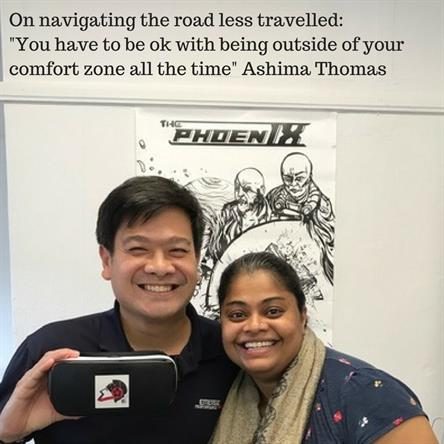
This is so cliché, but you have to be ok with being outside of your comfort zone all the time. I hear people say that a lot and you kind of think yeah, whatever. But until you live it, it’s really hard to explain to people what that means.
As a ‘pioneer’ of something, I feel that you are always doing things that are scary and unknown, so you have to be ok with that. As an entrepreneur with zero previous business experience, I feel that way.
It’s very interesting because you are creating a story using the VR platform, but at the same time your whole journey is a story in itself and some of the chapters have already been written. How do you think you want your story to continue?
I just hope that we keep moving forward. You hear about people who lose everything in their journey and then they build it back up. I feel – touch wood – that we have not been through that kind of low point yet. I just want to grow from strength to strength, even if it’s slow, but always moving towards that goal.
Thank you very much for sharing your story, Ashima! Wherever your journey takes you, I hope that you will continue to push boundaries and have a positive impact in the world. As Oz, the protagonist from PhoenIX, says: “Let me show you what the human race is really made of!”
For a sneak peek at what Ashima and her team are creating, check out the 2D version of The PhoenIX trailer and
a short behind-the-scenes video.