
High performance at work is not about asking people to run at maximum intensity every day. It is the ability to deliver meaningful results, keep learning, and recover well enough to do good work again. Individually, this means developing the right skills and reviewing what works. At team level, it means creating clear goals, useful working relationships, and the conditions for people to contribute their best thinking.
The world of elite sport offers a helpful comparison. Medal-winning athletes do not rely on motivation alone. They work on specific capabilities, use results as feedback, and build recovery into the wider training cycle. At work, a similar discipline can help people improve performance without confusing constant pressure with sustainable progress.
What Creates High Performance at Work?
At Emerge Performance, we view high performance as the result of clear outcomes, focused capability development, regular review, visible support and sustainable recovery. Strong performance is not about constant intensity; it is about creating the conditions that help individuals and teams deliver, learn and improve consistently.
Table of Contents
What High Performance at Work Means
A high performer is not simply the person who is busiest, most visible or willing to work the longest hours. High performance combines dependable delivery with judgement, learning and collaboration. In addition, a person may have strong technical expertise, but performance becomes more valuable when they can prioritise, adapt when conditions change and help the wider team succeed.
Leaders need to define high performance in context. For example, a sales team may look at customer value, quality of pipeline and responsible revenue. An operations team may focus on service, quality, safety and continuous improvement. A leadership team may need to make clear choices, align different functions and create commitment around a shared direction. Choose measures that reflect the work that matters, rather than rewarding activity for its own sake.
Three Habits High Performers Use
Train individual skills deliberately
Professional basketball players do not improve only by playing game after game. They break performance into component skills such as shooting, movement, strength and tactics. Similarly, the same principle applies at work. Instead of trying to be better at everything at once, identify one capability that will make the greatest difference to the role you have now.
For a manager, that capability might be setting expectations, giving feedback, delegating outcomes or running more effective one-to-ones. For a specialist, it might be improving stakeholder communication, data literacy, commercial judgement or a new technical skill. Choose one area, define what better looks like, practise it in real work and seek feedback on the result. Small, specific improvements are easier to sustain and easier to see.
Use setbacks as performance data
In sport, a disappointing result is reviewed for information: what worked, where did execution break down and what should change before the next event? A workplace setback can be approached in the same way. The goal is not to ignore accountability or explain away a poor outcome. It is to examine the evidence without blame so the next attempt is more informed.
After a missed deadline, difficult customer conversation or unsuccessful project, ask:
What outcome did we intend? What actually happened? Which assumptions proved wrong? What should we repeat, stop or test next?
This kind of review turns failure into learning and reduces the risk that teams repeat the same pattern. It also helps leaders model curiosity rather than defensiveness.
Make recovery part of the performance system
Elite athletes schedule periods of high effort alongside rest, not as a reward for being exhausted but as part of preparation for the next challenge. Work is different from sport, but the principle remains relevant. Sustained performance depends on the ability to focus, make sound judgements and stay engaged over time.
The American Psychological Association notes that time away from work can support psychological recovery and later job performance, especially when people are genuinely able to disconnect. Leaders can support this by planning workloads realistically, protecting breaks and leave, and avoiding signals that constant availability is the standard. Recovery does not remove the need for accountability; it helps make demanding work more sustainable.
How to Create a High Performance Plan
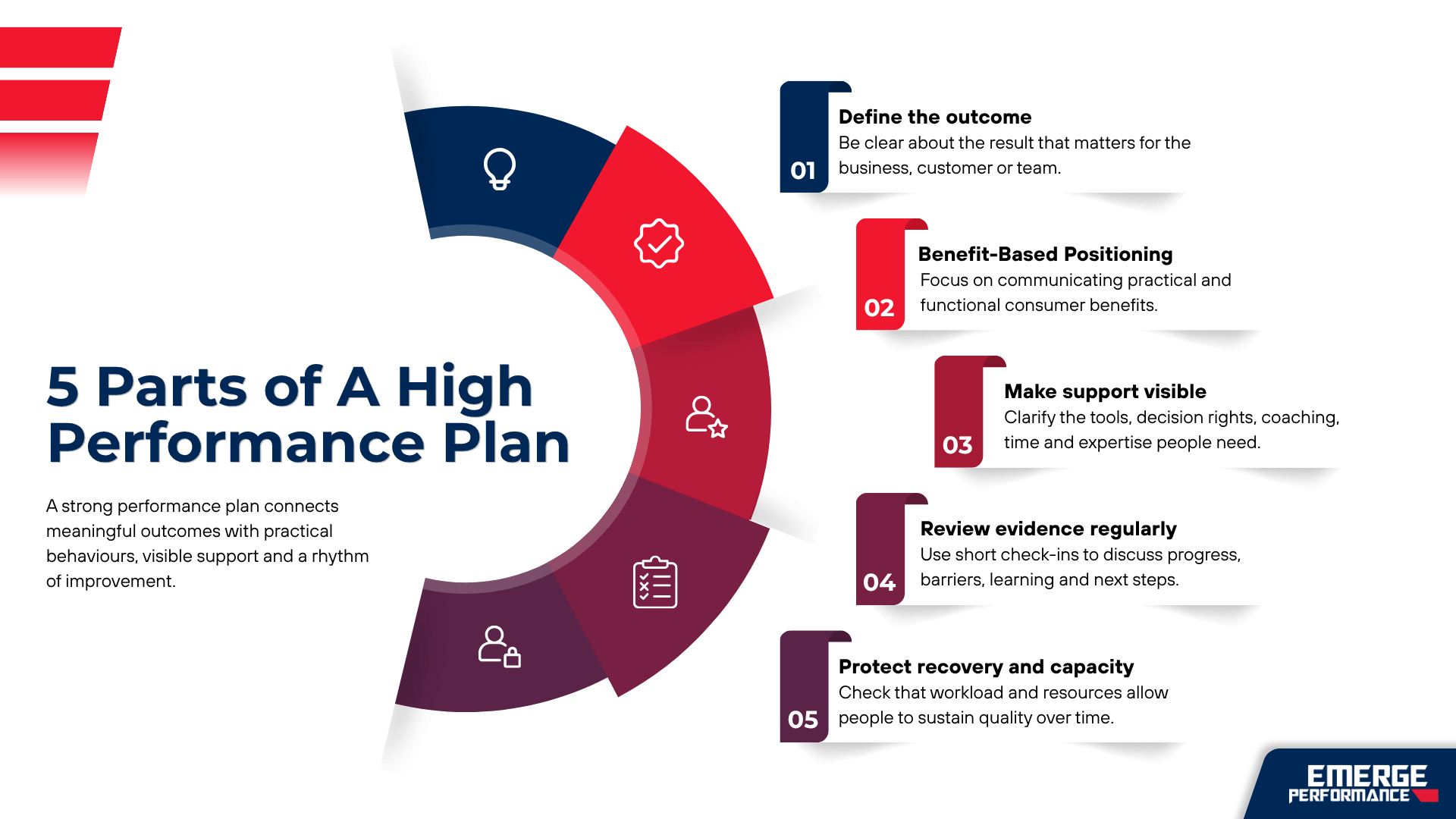
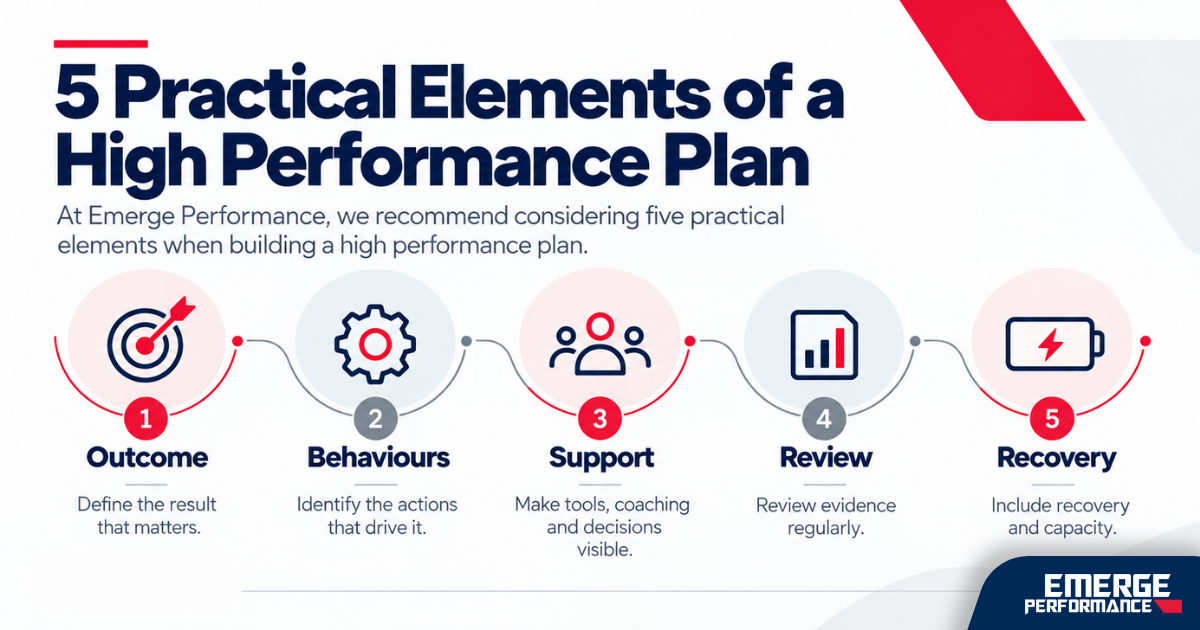
At Emerge Performance, we recommend considering five practical elements when building a high performance plan: outcomes, behaviours, support, review and recovery. It should not be a list of vague ambitions or a performance rating in advance. It is a way to focus effort and learn as the work unfolds.
A Five-Step High Performance Plan
- Define the outcomeState the business, customer or team result that matters and how progress will be recognised. Keep it specific enough that people can make trade-offs when priorities compete.
- Identify the critical behavioursDecide which few actions are most likely to influence the result, from escalating risks early to sharing information across functions.
- Make support visibleName the tools, decision rights, coaching, expertise or time that people need. Performance is rarely an individual effort.
- Review evidence regularlyUse a simple weekly or fortnightly check-in to discuss progress, obstacles, learning and next steps.
- Include recovery and capacityCheck whether workload, staffing and work patterns allow people to sustain quality. A plan that depends on permanent overload is a risk, not a high performance plan.
Create a Weekly Improvement Rhythm
High performance becomes easier to sustain when leaders build improvement into the week instead of saving it for a course, appraisal or crisis. A simple rhythm helps individuals and teams notice progress while there is still time to adjust. It also makes development feel like part of the work, rather than an extra task that disappears when workloads increase.
At the start of the week, agree the one or two outcomes that matter most and name any risks or dependencies. During the week, use a short check-in to ask what has changed, where a decision is needed and who needs support. At the end, spend a few minutes reviewing what moved forward, what slowed the work down and one improvement to carry into the next cycle.
Use short, evidence-based check-ins
This rhythm works best when it stays focused on evidence. A team does not need a long meeting to ask whether priorities were clear, whether information reached the right people or whether an early concern was acted on. Those questions help people make small corrections before missed handovers, unclear ownership or overloaded capacity become larger performance problems.
Turn feedback into visible action
For leaders, the discipline is to follow through. If people raise a barrier, clarify what will happen next and revisit it. If someone tests a better way of working, ask what they learned and whether the team can use it more widely. This creates a visible link between feedback, action and improvement – one of the strongest signals that performance conversations are meant to help people succeed, not merely assess them.
A weekly improvement rhythm also protects against the myth that high performers should solve everything alone. It gives people a normal place to ask for help, share expertise and reset priorities. Over time, that strengthens the information sharing and team reflection that credible evidence reviews associate with effective, high-performing teams.
How Leaders Build a High Performance Culture
A high performance culture is the set of shared expectations and everyday practices that help people deliver, learn and improve together. Instead, it is not a culture of fear, individual heroics or relentless urgency. It makes the purpose of the work clear, gives people the information and voice needed to contribute, and treats feedback as part of normal work.
Build clarity and shared ownership
The CIPD’s evidence review on high-performing teams highlights the importance of team dynamics, psychological safety, shared thinking, information sharing and team reflection. Crucially, these are not soft additions to performance. They affect whether people raise concerns, use the expertise available to them and coordinate around the same goal. In practice, leaders shape these conditions through what they reward, the questions they ask and how they respond when someone brings difficult news.
To begin, create a few reliable team rhythms: clear priorities at the start of a cycle, open discussion of risks and dependencies during the work, and a brief review afterwards. In addition, managers should be able to explain how each person’s contribution connects to the wider outcome. They should also make it safe to ask for help early, before a small obstacle becomes a delivery failure.
Equally, high performance also needs fairness and consistency. Expectations, feedback and development opportunities should not depend on who speaks most loudly or appears most confident. Use observable behaviours and evidence when reviewing performance. This makes standards clearer, helps people understand how to improve and supports trust in the system.
Make Performance Conversations More Useful
Importantly, performance conversations are where a high performance culture becomes real. If they happen only at an annual appraisal, they are often too late to remove obstacles or reinforce a useful behaviour. Regular conversations give managers and team members a chance to make priorities clear, identify what is getting in the way and agree the next practical action while the work is still moving.
For example, a useful conversation begins with evidence, not labels. Instead of saying that someone “needs to be more proactive”, describe the situation and the effect: a risk was raised after a decision had already been made, which limited the team’s options. Then ask for the person’s view of what happened. This approach keeps accountability clear while recognising that the person closest to the work may see constraints or information the manager has missed.
Four questions can keep the discussion focused:
What outcome are we trying to achieve? What is working or not working? What support, decision or capability is needed? What will we each do before the next review?
The answers create a shared record of progress and reduce the temptation to turn performance management into a vague judgement of attitude.
Leaders should also make room to recognise meaningful progress. Recognition is most useful when it is specific about the contribution and the value created, such as a colleague who shared an early customer concern that prevented rework. This reinforces the behaviours a high performance culture needs: sound judgement, information sharing, learning and collective ownership.

Measure Performance Beyond Output Alone
Although output measures matter, they are not the whole story. A team can meet a short-term target while creating customer problems, overloading key people or increasing risk elsewhere in the system. A more complete view considers the result alongside quality, customer or stakeholder value, collaboration, learning and capacity. The right balance will differ by role and industry, so measures should be chosen with the people who understand the work.
As a result, this balanced view does not make standards softer; it makes them more intelligent. When leaders review results alongside the way those results were achieved, they can distinguish a repeatable good practice from a one-off effort that depended on unsustainable pressure. That distinction helps organisations scale what works and intervene earlier when performance is being bought at too high a cost.
| Look beyond | Also consider |
|---|---|
| Output alone | Quality, customer or stakeholder value and delivery risk |
| Individual activity | Collaboration, information sharing and collective ownership |
| Short-term results | Learning, repeatability and sustainable capacity |
Key Takeaways
- High performance at work is sustainable delivery, learning and sound judgement – not constant intensity.
- High performers develop one relevant capability at a time, use setbacks as evidence and build recovery into their working rhythm.
- A high performance plan links a meaningful outcome to critical behaviours, visible support, regular review and realistic capacity.
- A high performance culture depends on clear direction, information sharing, psychological safety, reflection and fair performance conversations.
Develop High Performance Capability with Emerge Performance
Emerge Performance helps organisations strengthen leaders and teams while addressing the strategic, cultural and organisational conditions that enable sustainable performance. Through the
Leadership Performance Academy
, organisations can develop the practical capabilities that help people perform, adapt and grow through change.
Frequently Asked Questions
Why does a high performance plan matter?
A high performance plan is a practical agreement that defines a priority outcome, the behaviours that support it, the resources required and the rhythm for reviewing progress. It turns broad expectations into focused action, reveals obstacles early and gives people a clear basis for feedback and improvement.
Which characteristics define a high performer?
High performers reliably deliver meaningful work, prioritise well, learn from feedback, adapt to changing conditions and collaborate effectively. They are not defined by working the most hours. The stronger test is whether they improve outcomes while maintaining quality, good judgement and constructive working relationships.
How does a high performance culture work?
A high performance culture is an environment where people have clear purpose and expectations, access to information and support, opportunities to develop, and regular feedback on the work. It enables people to raise concerns, coordinate across roles and improve how results are achieved.
Which benefits does a high-performance culture create?
When it is designed thoughtfully, a high-performance culture can improve clarity, collaboration, learning and the organisation’s ability to adapt. It can also make performance conversations more useful because people understand the standards, evidence and support connected to their work. A culture built on pressure without voice, fairness or recovery is unlikely to be sustainable.