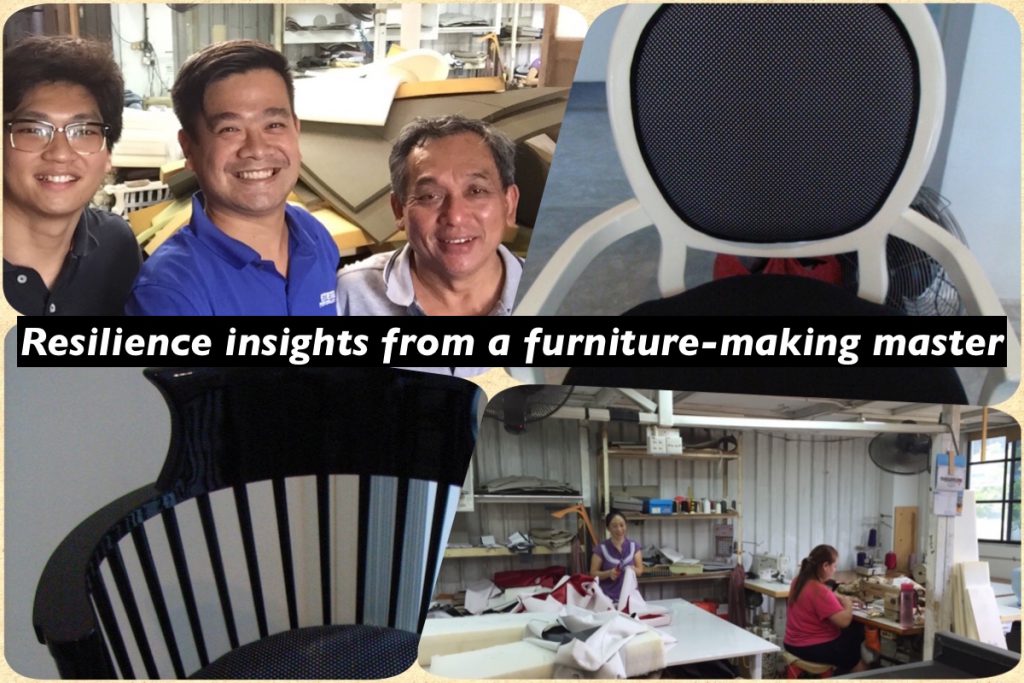
How many of us can lay claim to honing our craft for over 40 years? Well, not many. Meet furniture-making master and designer Kenneth Lim from Mega Marketing.
Hailing from humble roots in Malaysia, he moved to Singapore in 1974 and started out as a furniture apprentice. Fast forward 42 years and Kenneth is
still working with furniture – a testament to the fact that he is doing something right to stay in the game despite the numerous ups and downs of the
furniture industry in Singapore.
In this edition of our “In the Flow” series we’ll hear Kenneth’s story and explore the ingredients behind his success.
How did you get into this industry?
In 1974 I moved from a small town in Malaysia to be an apprentice in a small cane furniture shop here in Singapore. I worked in a cane furniture shop for about 6-7 years before starting on my own. From the early 80s to 1998, my business was manufacturing and selling cane furniture. We had our own factory in Malaysia.
The late 70s to the early 90s was the golden period for cane furniture. A lot of expatriates were moving to Singapore as a result of the rapid industrial development in Singapore. When they came, they came with the whole family and the first thing they looked for was cane furniture. They were really into it. I told my boss then that we had to diversify or improve the business by increasing the variety of the furniture we offered. In those days, the furniture was simple designs. Later on I told him that we had to do stuff like staining and include more design in the furniture we sold.
A lot of expatriates were also bringing in their own designs from magazines to custom make. That’s how we got known in the expatriate market. We were a made-to-order company. At the height of the early 80s, we were also trying to export to Europe. But for some reason, we couldn’t compete with countries like the Philippines and Indonesia. So we decided to focus on showroom sales. At its height, we had four showrooms throughout Singapore. In one instance, we had 10 expatriate families from Intel ordering all their furniture to be made by us. Well, cane is handmade and therefore production can be slow. So the waiting time was quite long and some customers became unhappy. From there, I realized that if we slowly manufactured the furniture ourselves, the problem would not be resolved. So I started my own business with a cane showroom and importing from the Philippines and Indonesia. We also offered unique designs combining wrought iron with cane weavings in the furniture we sold. One day we could sell three containers of such furniture. We also demonstrated the variety that was possible and tried to reap the economies of scale wherever we could.
The golden period lasted to the mid-90s before things started to dwindle down. The early 80s was the start of the golden period of cane furniture manufacturing during which expatriate demand was high, as they couldn’t find it back in their home countries. But later on in the late 80s, many companies in Indonesia and the Philippines started to export directly to Europe. So popularity slowed down and there was a switch in demand. Around 1995, things were really slowing down and we had to think of alternatives. The currency crisis in 1997 sent the regional economy into a tailspin. We were really trapped. At the height of my business, we were paying almost $80,000 per month for all the overheads. And things were taking a nosedive. It was bad! We used to have a shop in Holland Village on Lorong Mambong and we negotiated with the landlord to reduce the almost $20,000 in rental. It was very expensive. A lot of shops came and left.
So we took on a different approach in 1998 and looked at contract furniture, including upholstery, custom orders, hotel furniture, F&B and institutional supplies – for example, for offices. That’s how I survived till today. All this while, we were custom-making furniture and that’s how I gathered my incremental knowledge of what and how a chair – say a dining chair or sofa – should be produced and other related specifications. I really felt down before the switch. But I said I had to find my own path. At the other end of the tunnel was a light and so I bulldozed on.
What gave you the encouragement to push on?
Over the years, I had a lot of customers and I contacted them and others through recommendations and sought them out. And that’s how I got my clients. Slowly building up from scratch all the way up till today.
Your relationship with customers must have been quite good?
The important thing is my knowledge on furniture. Whatever questions they ask, I have to be able to more or less respond and address their needs. And I also have to be responsible. Up to today, we do a lot of refurbishment work and my philosophy is that whatever we do, we will do our best to recondition and refurbish the item to the best of our abilities. We have to put ourselves in the position of very discerning customers. We have to make sure we are happy ourselves with the quality. Our emphasis is on providing the best quality we can.
Sometimes in restoration work with old furniture there is no limit to the amount of time we spend to get the job done, but still charge only $100 for a piece of furniture. But that’s part and parcel of the work. So we just do it and do it well so people don’t come back with complaints.
The satisfaction is when a piece of furniture is done and done nicely. That’s the biggest satisfaction. A lot of other countries and competitors don’t do that. They short-change you here and there – the materials, for example. But I don’t. I am also fortunate to have a very good team of workers. They are fantastic and take pride in their work – in doing things well. This is the philosophy I instil in them. Make sure things are done properly. You must be satisfied before it leaves the factory.
If you do it in a half-hearted way, the thing is not done nicely and customers are not happy, then we have to take it back and redo it. Ultimately, more time and effort are wasted, and our reputation also drops.
Sounds like producing well-designed furniture is a key to your success. What are some of your considerations when you design furniture?
It was in manufacturing cane furniture where I started to design furniture. I can draw, which was an advantage. Customers were impressed by the drawings and over the years I’ve put up numerous new designs. Quite often I had to formulate ideas based on the customer’s requirements. So my ability to translate their ideas into drawings or illustrations really helped. Drawing was the key – the ability to communicate the idea to meet the customer’s requirements.
Over the years, I also learnt about the furniture trade regarding the basics of sizes and related specifications. For example, looking at a simple floor plan, I’m able to give basic advice about appropriate furniture sizes. We do quite a lot of F&B orders and as a furniture maker we have to give feedback to the designer or owner about the sizes – for example, this may be too big, too deep, etc. – so that the final product will be satisfactory. Sometimes the sizes they want may not be suitable to the area, so we have to give our inputs as well. This comes from knowledge built over the years with design and space management.
With the slowing economy, what is some advice you would give to the working professional out there?
A lot of us want only comfortable jobs. We have to be willing to get our hands dirty. So take on dirty jobs and work hard. We also have to adapt to the changing environment. There are always opportunities when you innovate.
Take risks and venture out. I know a lot of people in Malaysia who are not well educated, but they are doing big business in the furniture industry because they dare to venture out. We must be willing to strive and fend for our living.
Thank you for sharing, Kenneth. In light of the current economic uncertainty and concerns about jobs, your story has provided insightful lessons about mastering our craft with continuous adaptation, lifelong learning and taking personal pride in our work.
If you have any furniture requirements, feel free to get in touch with Kenneth – here are his contact details:
Kenneth Lim
Mega Marketing & Services Pte Ltd
Cellphone: 9237 3246
Email: [email protected]
If you want to receive the latest “In the Flow” interviews, along with tried and tested tips on mindfulness and other performance enhancement techniques , please sign up to our (only once-a-month) newsletter using the following link, i.e. www.emergeperformance.net/newsletter.html