Earning an ACC, PCC, or MCC Credential is a meaningful professional milestone. It shows that you have invested in coach education, coaching experience, ethical practice, and the competencies required to support individual clients well.
It can also create a new career question: what should come next?
Some coaches choose to deepen their work in executive, leadership, career, or another specialist area. Others become increasingly interested in challenges that do not sit within one person: leadership teams that cannot align, cross-functional groups caught in recurring conflict, or organisations whose transformation efforts stall because capable leaders are not working as one team.
This is where team coaching becomes relevant. It does not replace professional coaching, nor is it simply one-to-one coaching with more people in the room. It is a distinct specialisation that treats the team as the client and works with collective dynamics, shared purpose, relationships, decision-making, and the wider organisational system.
This guide compares professional coaching and team coaching, helps you assess which career direction fits you, explains how the ICF Advanced Certification in Team Coaching (ACTC) relates to ACC, PCC, and MCC, and outlines what to look for in a credible team coaching programme.
Quick answer
Continue specialising in professional coaching if you are most energised by confidential one-to-one work and individual development. Consider team coaching if you are drawn to live group dynamics, systems thinking, collective performance, and organisational change. Many experienced coaches ultimately build both capabilities, but team coaching requires additional education, practice, supervision, and organisational judgement.
Why this career question often emerges after ACC, PCC, or MCC
Professional coaching is often experienced one-on-one with a client. Yet many of the problems organisations bring to coaches are collective. A newly appointed executive may benefit from individual coaching, but a leadership team with conflicting priorities, unresolved tension, or slow decision-making needs a different intervention.
High-performing individuals do not automatically create a high-performing team. A group of capable leaders may still struggle with unclear shared purpose, functional silos, low trust, uneven participation, or accountability that stops at departmental boundaries. These patterns are created between people and reinforced by the wider system, so they cannot always be resolved by coaching each person separately.
For credentialed coaches, this creates an opportunity to expand the level at which they can work. The decision is not whether individual or team coaching is more advanced. It is whether you want to deepen individual work, develop a collective and systemic specialisation, or integrate both in a coherent practice.
Emerge Performance insight
The difficult transition is rarely learning another set of models. It is learning to hold the whole team in view while several conversations, power dynamics, emotions, and stakeholder expectations are active at the same time. Structured practice, observed feedback, and coaching supervision matter because this judgement develops in use, not through theory alone.
What is professional coaching?
The International Coaching Federation (ICF) defines coaching as “partnering with clients in a thought-provoking and creative process that inspires them to maximize their personal and professional potential.” Read the ICF explanation of professional coaching.
In professional coaching, the client is commonly an individual. The coach creates a confidential and collaborative space where the client can clarify goals, challenge assumptions, build awareness, make choices, and take responsibility for action. The coach does not take over the client’s decisions or prescribe a solution.
The effects of individual coaching can extend beyond the client. A leader who becomes more self-aware, resilient, or effective may positively influence a whole team. Even so, the coaching agreement and development agenda remain centred on that individual.
Professional coaching is often the better fit when:
- A newly promoted leader wants to build confidence, strategic presence, or influence.
- An executive needs confidential space to think through a sensitive stakeholder or business challenge.
- A manager wants to strengthen communication, resilience, or decision-making.
- A professional is navigating a career transition, new role, or change in identity.
- The desired outcome is individual awareness, behavioural change, goal progress, or capability development
What is team coaching?
Team coaching is a specialised form of coaching in which the team, rather than one member, is the primary client. The coach partners with an interdependent team to increase awareness of its dynamics and relationships, strengthen its collective capability, and make progress towards a common purpose and shared goals.
The most important shift is therefore not the number of people present. It is who the client is. Coaching six members of one team separately remains six individual coaching engagements. Team coaching begins when the team is contracted and treated as the client, with shared outcomes and attention to what happens between members.
ICF’s Team Coaching Competencies build on the ICF Core Competencies and add the context-specific knowledge and skills needed to work with team dynamics, multiple stakeholders, participation, conflict, autonomy, and sustainable collective learning. Explore the official ICF Team Coaching Competencies.
A team coach pays attention to questions such as:
- How does the team make decisions when priorities compete?
- Whose voices shape the conversation, and whose remain unheard?
- How does the team respond to disagreement, hierarchy, uncertainty, and pressure?
- Which patterns strengthen or weaken accountability and execution?
- How do stakeholders experience the team?
- What agreements would help the team deliver its shared purpose more effectively?
Team coaching uses a systemic lens
Teams do not operate in isolation. Their behaviour is shaped by organisational structures, incentives, leadership expectations, history, culture, stakeholders, and external pressures. Effective team coaching therefore goes beyond improving communication inside a meeting. It helps the team see how the system influences its choices and how the team influences the system in return.
This systemic orientation is one of the main reasons an excellent individual coach does not automatically become an effective team coach. The coach must remain attentive to individuals while serving the collective client and the purpose of the engagement.
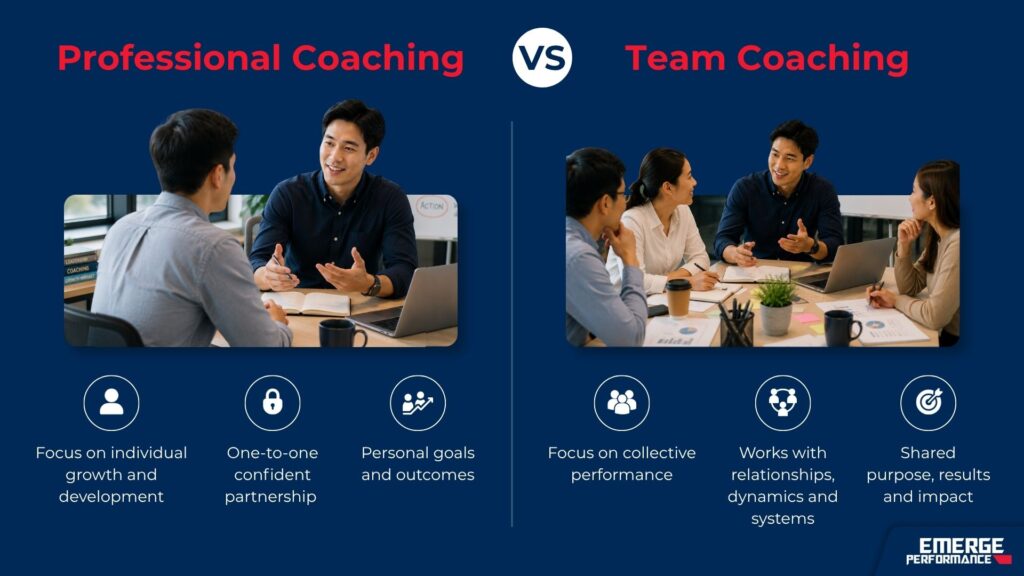
Coaching vs. Team Coaching: Key Difference
| Dimension | Professional Coaching | Team Coaching |
|---|---|---|
| Primary client | An individual | The team as a collective entity. |
| Primary purpose | Individual growth, decisions, performance, or transition. | Collective effectiveness, shared learning, and team performance. |
| Focus of attention | The client’s thinking, behaviours, goals, and choices. | Interactions, relationships, patterns, shared work, and the wider system. |
| Typical conversation | Usually one-to-one. | The team works and reflects together. |
| Success indicators | Insight, behaviour change, goal progress, and individual capability. | Alignment, decision quality, trust, accountability, learning, and shared results. |
| Contracting | Client and, where relevant, an organisational sponsor. | Team, team leader, sponsor, and other relevant stakeholders. |
| Confidentiality | Centred on the individual coaching agreement. | Requires explicit agreements across multiple parties and clarity about what remains within the team. |
| Coach capabilities | Core coaching competencies and ethical practice. | Core competencies plus systems awareness, team dynamics, multi-party contracting, conflict capability, and collective learning. |
| Typical use cases | Executive, leadership, career, transition, and development coaching. | Executive, leadership, cross-functional, transformation, project, and product teams. |
A simple distinction
Professional coaching asks, “What does this individual need to see, choose, or change?” Team coaching asks, “What does this team need to learn and change together?”
Team coaching vs. group coaching, facilitation, team building, and training
These approaches can complement one another, but clear distinctions help clients choose the right intervention and protect ethical role boundaries.
| Approach | Primary focus | Typical purpose | Key distinction |
|---|---|---|---|
| Individual coaching | One person | Individual growth and goal attainment | The individual agenda is central. |
| Group coaching | Individuals learning in a group setting | Support each participant’s development through coaching and shared learning. | Participants may have related themes but do not need a shared team purpose or interdependent results. |
| Team coaching | An intact or real team | Improve collective effectiveness and shared results. | The team itself is the client. |
| Facilitation | A meeting, workshop, or decision process | Help a group complete a process or produce an output. | The facilitator guides the process; ongoing team development may not be the objective. |
| Team building | Relationships and connection | Increase familiarity, trust, or cohesion through activities. | Often event-based and may not address deeper performance patterns. |
| Training | Knowledge or skill development | Teach defined concepts, tools, or behaviours. | The trainer provides content and instruction. |
Role clarity matters
A team coach may facilitate a discussion, teach a model, or use a diagnostic. The coach should make any role shift transparent so the team understands whether the practitioner is coaching, facilitating, training, or consulting at that moment.
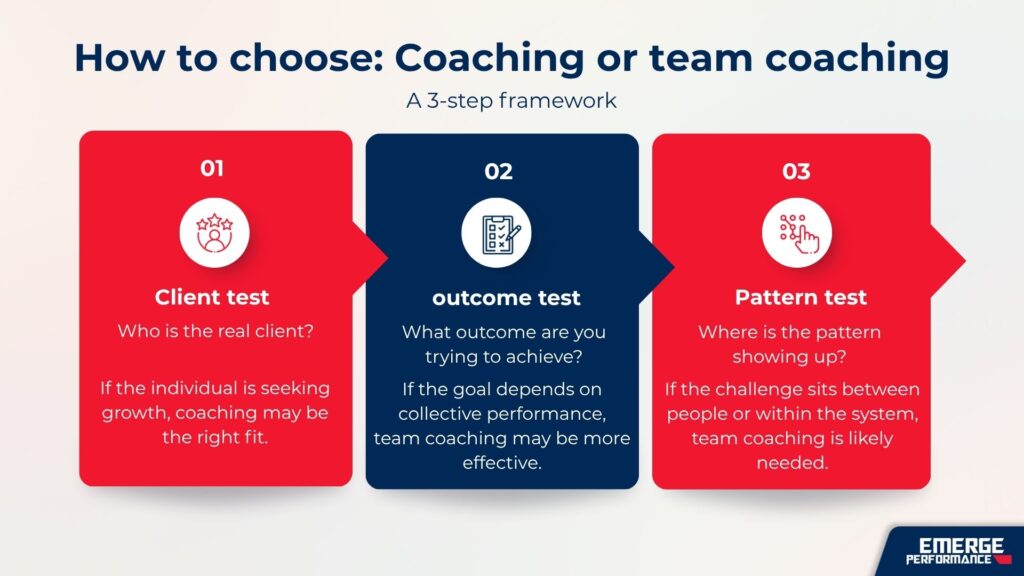
When should you choose each path?
Start with the challenge, not with the service you are most comfortable delivering. Three tests help clarify the right starting point.
1. The client test: who owns the challenge?
If the challenge primarily belongs to one leader, professional coaching is usually the better starting point. If the challenge persists between members or across shared work, team coaching deserves consideration
2. The outcome test: what must change?
Individual outcomes include confidence, judgement, resilience, leadership presence, and personal behaviour. Team outcomes include alignment, decision quality, productive conflict, shared accountability, stakeholder value, and collective adaptability.
3. The pattern test: where does the problem live?
If the pattern follows one person across contexts, individual coaching may be appropriate. If the pattern repeatedly emerges through interactions, role boundaries, incentives, power, or unresolved history, the team and system need to be involved.
| Situation | Best starting point | Why |
|---|---|---|
| A newly appointed leader wants to develop confidence and strategic presence. | Professional coaching | The main need is individual reflection and development. |
| A leadership team repeatedly leaves meetings with different priorities. | Team coaching | The issue is collective alignment and decision-making. |
| Several leaders need separate development support, but the team works well. | Professional coaching for each relevant leader | The development needs are individual rather than systemic. |
| A cross-functional team is caught in recurring conflict and blame. | Team coaching | The pattern exists between functions and affects shared performance. |
| A transformation requires leaders to change personally and act as one team. | Individual coaching plus team coaching | Both individual leadership and collective execution need attention. |
| A group must reach a decision in a two-hour workshop. | Facilitation | The immediate need is a designed process and output, not necessarily an ongoing coaching engagement. |
When both approaches work better together
Professional coaching and team coaching are complementary. A leadership team may need to improve collective decision-making while individual executives work privately on influence, resilience, or the transition into enterprise leadership.
The design still requires care. Sponsors, coaches, and clients should agree how confidentiality will be protected, how insights will be used, and whether individual and team coaching should be provided by the same practitioner or different coaches.
What changes when a coach begins working with teams?
Strong one-to-one coaching is an essential foundation, but team coaching widens the coach’s field of attention from one client’s internal world to several people, live relationships, power dynamics, stakeholder expectations, and patterns unfolding in real time.
| Capability | What it looks like in practice |
|---|---|
| Systems awareness | See the connections among team behaviour, structures, incentives, stakeholders, culture, and organisational context. |
| Multi-party contracting | Create clear agreements with the team, team leader, sponsor, and other stakeholders while protecting trust and confidentiality. |
| Listening to the whole system | Hear individual voices while noticing participation, alliances, silence, energy, conflict, and collective assumptions. |
| Working with conflict and power | Remain present when disagreement, hierarchy, identity, or political tension enters the room. |
| Facilitating collective learning | Help the team reflect on its work, generate insight, experiment, and take shared responsibility for change. |
| Maintaining role clarity | Know when coaching is appropriate and make any shift into facilitation, teaching, or consulting explicit. |
| Reflective practice and supervision | Review ethical dilemmas, personal reactions, and interventions with sufficient depth to keep developing. |
Why practice and supervision are essential
A team coach may understand a model intellectually and still struggle when a senior leader dominates, a sponsor expects confidential reporting, or conflict becomes personal. These are not merely knowledge gaps. They require judgment, presence, ethical clarity, and the ability to act without taking control of the team.
Observed practice and coaching supervision allow coaches to review what they noticed, what they missed, how they used themselves in the room, and what alternative interventions were available. This is one of the strongest indicators that a programme is designed to build capability rather than simply deliver content.
Is team coaching the right next step for you?
Team coaching is not a mandatory next level after ACC, PCC, or MCC. It is a specialisation that may fit coaches who want to work at the intersection of leadership, team performance, and organisational systems.
Use the following questions as a reflection exercise rather than a pass-or-fail test.
| Reflective question | Why it matters |
|---|---|
| Do you enjoy live group dynamics, not only one-to-one dialogue? | The work requires attention to several people and to what happens between them. |
| Can you remain curious when disagreement, silence, or strong emotion emerges? |
Avoiding tension can leave the team’s most important patterns untouched. |
| Are you interested in organisational systems and stakeholder relationships? |
Team effectiveness is influenced by forces beyond the immediate team. |
| Are you comfortable creating agreements with sponsors and multiple clients? |
Team coaching involves more complex contracting and confidentiality decisions. |
| Are you willing to practise, receive feedback, and use coaching supervision? |
Conceptual knowledge is not enough for complex live team work. |
| Do you have, or can you develop, access to real teams and organisational buyers? |
A specialisation becomes commercially meaningful when it connects to genuine client needs and practice opportunities. |
A realistic career perspective
Team coaching can broaden the type and scale of work you are able to support, but no certification guarantees clients, assignments, or income. Credibility also depends on real team experience, ethical judgement, organisational fluency, relationships, and your ability to demonstrate useful outcomes.
If these questions describe the work you want to do, The Team Coach (TTC) offers a structured way to build the specialist capability that individual coach training does not fully cover.
How ACTC fits with ACC, PCC, and MCC
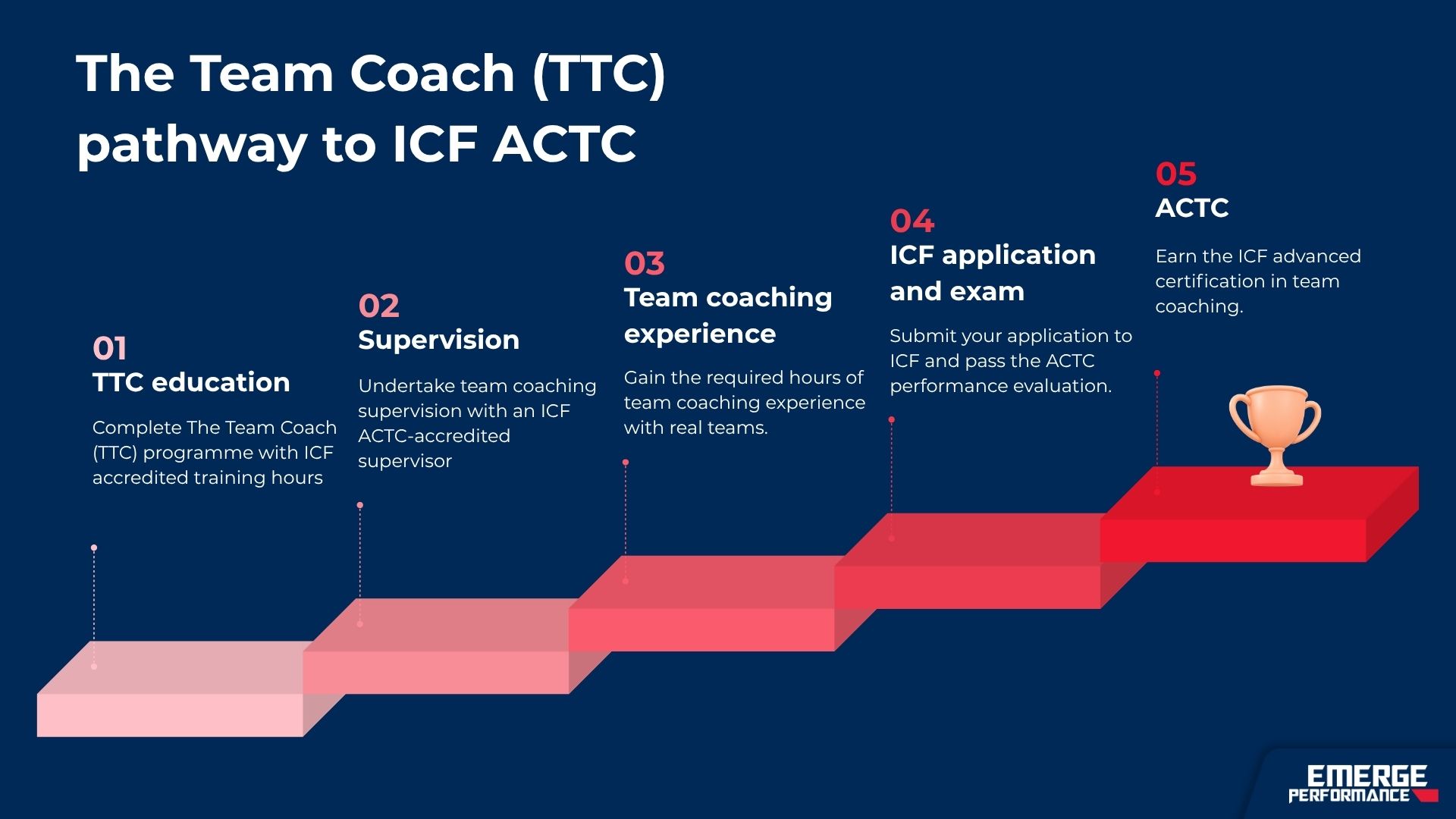
The ICF Advanced Certification in Team Coaching (ACTC) recognises specialised knowledge and competence in team coaching. It complements an active ICF Credential; it does not replace ACC, PCC, or MCC and is not positioned as a credential level above MCC.
Terminology matters because “ICF certification” is widely searched but can blur several different forms of recognition.
| Recognition | Applies to | What it demonstrates |
|---|---|---|
| ACC, PCC, MCC | An individual coach | Progressive levels of professional coaching competence and experience. These are ICF Credentials. |
| ACTC | An ICF-credentialed coach specialising in team coaching | Advanced knowledge and competence in team coaching. This is an ICF Advanced Certification. |
| Advanced Accreditation in Team Coaching | A coach education programme or provider | The team coaching education meets ICF accreditation standards. |
Current ACTC eligibility requirements
As of July 2026, ICF lists the following core requirements for the standard ACTC pathway:
- An active ICF Credential at any level, in good standing.
- At least 60 hours of team coaching education.
- Five team coaching engagements completed within the relevant five-year period.
- At least five hours of coaching supervision.
- A passing score on the ICF Team Coaching Certification Exam.
ICF offers different application routes depending on the education and experience used. Requirements, fees, and application arrangements can change, so confirm the latest information directly with ICF’s ACTC guidance before applying.
Important distinction
A training provider can explain how its programme supports the ACTC pathway, but ICF determines eligibility and awards the ACTC. Completing a programme is not the same as automatically receiving the ACTC.
How to choose a credible team coach training programme
A credible programme should do more than explain frameworks. It should help you develop the judgement, presence, ethics, and systems awareness required in real team settings.
| Evaluation criterion | Questions to ask |
|---|---|
| ICF status and claims | Verify the programme’s current accreditation and understand precisely which ACTC requirements it supports. |
| Team coaching curriculum | Look for ethics, contracting, team dynamics, systems thinking, conflict, stakeholder work, collective learning, and impact evaluation. |
| Live and observed practice | Prioritise programmes that include practice with feedback rather than theory alone. |
| Coaching supervision | Confirm the number, format, focus, and eligibility of the supervision hours. |
| Faculty experience | Ask whether faculty members actively coach real leadership and organisational teams. |
| Real-world transfer | Look for methods and tools that translate to executive, cross-functional, transformation, and multicultural contexts. |
| Cultural relevance | Evaluate how the programme addresses hierarchy, language, identity, power, and cross-cultural dynamics. |
| Continued application | Assess how the programme supports reflection, peer learning, and access to practice after the formal modules. |
How The Team Coach (TTC) supports the transition
Emerge Performance’s The Team Coach (TTC) is designed for experienced coaches, internal leaders, facilitators, and L&D professionals who want to build practical capability in coaching real teams. For coaches pursuing ACTC, the programme is positioned as an ICF-accredited pathway that supports the required team coaching education and coaching supervision components.
The programme’s purpose is not to make individual coaching less relevant. It is to help practitioners expand from listening deeply to one person to listening to the whole team system, working with complexity without taking over, and turning live team experience into collective learning.
| TTC component | How it supports your development |
|---|---|
| 60+ hours of team coaching education | Build a structured foundation across team coaching principles, ethics, contracting, dynamics, diagnostics, resilience, and impact. |
| Nine core modules | Progress from the foundations of team coaching to working with trust, action learning, team development, diagnostics, impact, and complex dynamics. |
| Five hours of group supervision | Reflect on real coaching experiences, examine ethical and relational challenges, and deepen professional judgement. |
| Practice, feedback, and application | Move beyond theory through guided practice, observed work, tools, templates, and feedback. |
| Reflection and research | Use reflective and research papers to integrate models with your own coaching practice and organisational context. |
| Performance psychology lens | Draw on principles from elite sport, military leadership, and executive performance to understand how teams adapt and perform under pressure. |
| Flexible, international learning | Join an online programme designed for working professionals, with English and Chinese learning options. |
What TTC supports—and what remains your responsibility
| Part of the pathway | Responsibility |
|---|---|
| Included through TTC | 60+ hours of team coaching education and five hours of coaching supervision, alongside the programme’s practical and reflective components. |
| Your professional practice | Complete and document the required team coaching engagements within ICF’s eligibility period. |
| Administered by ICF | Submit the ACTC application, meet all eligibility requirements, and pass the ICF Team Coaching Certification Exam. |
Why this matters
A team coaching programme should not only help you qualify on paper. It should change what you are able to notice, hold, and do when a real team is under pressure. TTC is designed around that transition from knowledge to applied capability.
Career opportunities and realistic expectations
Team coaching capability can enable a coach to support more complex organisational work where success depends on interdependence rather than individual performance alone. Potential contexts include executive
and senior leadership teams, cross-functional and transformation teams, regional or multinational leadership teams, project and product teams, internal coaching functions, and leadership programmes that integrate individual and team development.
The commercial model can also be different. Team coaching often involves longer sales cycles, more stakeholders, deeper contracting, and stronger expectations that the coach understands organisational context and can discuss outcomes responsibly.
An ACTC or an accredited education programme can strengthen credibility, but organisations still evaluate coaches through a wider lens: relevant experience, references, cultural fit, ethical judgement, business understanding, and evidence that the coach can help a team create meaningful change.
Three practical career paths after ACC, PCC, or MCC
| Path | What it involves | Who it may fit |
|---|---|---|
| Deepen individual coaching | Specialise further in executive, leadership, career, wellbeing, or another one-to-one niche. |
Best for coaches who gain most energy from confidential individual partnerships. |
| Add team coaching | Develop a recognised specialisation that expands your work into leadership teams and organisational systems. |
Best for coaches drawn to collective dynamics, complexity, and shared performance. |
| Integrate both | Offer individual and team coaching as complementary interventions, with clear boundaries and contracting. |
Best for coaches building deeper organisational partnerships across several levels. |
Frequently asked questions
1. What is the main difference between coaching and team coaching?
Professional coaching usually works with an individual client and focuses on that person’s goals, awareness, choices, and development. Team coaching treats the team as the client and focuses on collective dynamics, shared work, relationships, learning, and performance.
2. Is team coaching simply individual coaching with more people?
No. The defining distinction is not group size. In team coaching, the engagement is contracted around the team’s shared purpose and collective outcomes, and the coach pays attention to what happens between members and within the wider system.
3. Is team coaching the same as group coaching?
No. Group coaching normally supports individuals who learn together but retain their own goals. Team coaching works with an interdependent team that has shared work, a common purpose, and collective results.
4. Do I need ACC, PCC, or MCC before learning team coaching?
Not necessarily. Depending on the programme and your role, you may begin learning team coaching without an ICF Credential. To apply for the ICF ACTC, however, you must hold an active ACC, PCC, or MCC
Credential in good standing.
5. Is ACTC higher than MCC?
No. MCC is an ICF Credential level for professional coaching. ACTC is an advanced certification in the specialised discipline of team coaching and complements an active ACC, PCC, or MCC Credential.
6. Can one coach provide both individual and team coaching?
Yes, but the design requires careful contracting. Confidentiality, sponsor expectations, potential conflicts of interest, and the coach’s ability to remain trusted by the whole team should be considered before combining roles.
7. How long does a team coaching engagement take?
There is no universal duration. Meaningful engagements often unfold over several months because teams need time to apply new agreements, observe patterns in real work, and learn from results.
8. Does completing TTC automatically give me the ACTC?
No. TTC supports the education and coaching supervision components described by the programme. You must also meet ICF’s experience and application requirements and pass the ICF Team Coaching Certification Exam.
9. What makes TTC different from a theory-only course?
TTC combines structured education with practice, group supervision, reflective work, real-world tools, and a performance psychology lens. The emphasis is on developing capability for complex live team contexts, not only understanding models.
10. Does ACTC guarantee more clients or higher income?
No professional certification guarantees commercial success. It can strengthen your credibility, but opportunities also depend on experience, relationships, organisational understanding, business development, and demonstrated value.
Key Takeaways
- Professional coaching develops an individual client; team coaching develops the team as a collective entity.
- The right intervention depends on where the challenge lives, what outcome is required, and who owns the work.
- Team coaching is distinct from group coaching, facilitation, team building, training, and consulting, even when some methods overlap.
- One-to-one coaching skills remain foundational, but team coaches also need systems awareness, multi-party contracting, conflict capability, role clarity, and supervised practice.
- ACTC is an ICF Advanced Certification that complements an active ACC, PCC, or MCC Credential; it is not a level above MCC.
- Team coaching can expand your professional scope, but credibility still depends on experience, ethics, relationships, organisational fluency, and demonstrated value.
- TTC is designed to help coaches convert individual coaching foundations into practical team coaching capability while supporting key elements of the ACTC pathway.
Conclusion: Choose the Level at Which You Want to Create Change
The question is not whether professional coaching or team coaching is better. The more useful question is: at what level does change need to happen—and at what level do you want to work?
When one person needs space to think, grow, and choose, professional coaching can be powerful. However, if challenges stem from relationships, shared decisions, or organizational patterns, the team must learn together. Ultimately, combining individual leadership with collective performance creates the greatest value.
For an ACC, PCC, or MCC coach, team coaching is best understood not as an automatic promotion but as a demanding and meaningful specialisation. It asks you to widen your lens, deepen your practice, and become more capable of working with the complexity that real teams bring.