Team culture rarely breaks overnight. It drifts through small, repeated patterns: people stop challenging ideas, accountability becomes defensive, stated values lose their meaning, and unresolved tension starts to feel normal. A team culture reset is a deliberate process for recognising those patterns and realigning how the team communicates, decides, learns and delivers together.
The five signals at a glance: A reset may be needed when (1) people avoid honest conversations, (2) energy and ownership decline, (3) accountability becomes blame-oriented or unclear, (4) stated values are not reflected in everyday behaviour, and (5) unresolved tension or unwanted turnover becomes normal.

Table of Contents
- What is a team culture reset?
- Five signs your team culture needs a reset
- Is it a culture problem—or something else?
- How to reset team culture: a six-step framework
- A sample 90-minute team reset conversation
- How to measure whether the reset is working
- When team coaching or external facilitation can help
- Frequently asked questions
- Key takeaways
What Is a Team Culture Reset?
A team culture reset is a structured pause to examine the unwritten rules and repeated behaviours shaping how a team works, then agree on what needs to change. The objective is not to erase the team’s history or launch another set of values. It is to make the current culture visible, retain what is working, and replace patterns that no longer support the team’s purpose or performance.
Culture is often described as “how things are done around here”. At team level, it is expressed through everyday moments: whose views are heard, how decisions are made, what happens after a mistake, which behaviours are rewarded, and whether commitments are followed through.
What a Team Culture Reset Should Achieve
- Create a shared understanding of the team’s current patterns, without turning the conversation into a blame exercise.
- Reconnect the team’s purpose and priorities with the behaviours needed to deliver them.
- Clarify decision-making, accountability, communication and conflict norms.
- Give team members a meaningful voice in shaping how they work together.
- Establish visible commitments and a rhythm for reviewing progress.
A culture reset is not a morale event. An off-site, social activity or values workshop may create energy, but it will not change culture unless leaders and team members translate the discussion into observable behaviours, clear working agreements and consistent follow-through.
Five Signs Your Team Culture Needs a Reset
| Signal | What you may notice | Underlying risk | First question to ask |
|---|---|---|---|
| 1. Silence and avoidance | Few questions, little dissent, difficult topics move into private conversations | Low psychological safety and weak learning | What has become harder to say here? |
| 2. Low energy and ownership | Passive meetings, reduced initiative, “not my job” behaviour | Disconnection from purpose, priorities or leadership | What is draining energy or making ownership harder? |
| 3. Blame or unclear accountability | Finger-pointing, repeated missed commitments, feedback withheld | Defensiveness and unreliable execution | Are expectations, authority and consequences genuinely clear? |
| 4. Values–behaviour gap | Collaboration is stated but individual heroics are rewarded; wellbeing is promoted but overload is normalised | Loss of trust and cultural cynicism | What do our decisions show we truly value? |
| 5. Persistent tension or turnover | Recurring conflict, silo behaviour, high performers leaving, constant backfilling | Relational breakdown or wider system problems | Which unresolved pattern keeps repeating? |
1. People Withdraw From Honest Conversations
One of the earliest signs of cultural drift is not open conflict, but silence. Team members stop questioning assumptions, raising risks or asking for help. Meetings remain polite, yet the real conversation happens afterwards, in smaller groups or not at all.
Psychological safety does not mean constant agreement or avoiding high standards. It means people believe they can ask a question, admit a mistake, challenge an idea or offer a different perspective without being embarrassed or punished. Harvard Business School describes it as an environment in which candour is expected and people can speak up without fear of retribution. In Google’s research on its own teams, psychological safety emerged as the most important of five team dynamics associated with effectiveness.
What this may look like
- The same few people dominate discussions while others contribute only when invited.
- Risks and concerns appear late, after decisions have already been made.
- People agree in the meeting but resist, delay or reinterpret the decision afterwards.
- Team members avoid giving upward feedback or challenging a senior colleague.
- Mistakes are hidden, softened or explained away instead of examined openly.
A useful first step is to ask: “What has become harder to say in this team?” Leaders should answer first and acknowledge their own contribution. That signals that the conversation is about learning, not identifying a culprit.
Do not diagnose culture from quietness alone. A reflective or culturally diverse team may communicate differently from a highly verbal one. Look for whether people can express disagreement and uncertainty when it matters—not simply how much they speak.
2. Motivation, Energy and Ownership Are Declining
Low energy is often treated as an individual attitude problem. Sometimes it is. But when reduced initiative, passive participation and “not my job” behaviour appear across a team, leaders should examine the wider environment.
Gallup’s State of the Global Workplace 2026 reports that only 20% of employees globally were engaged in 2025. Gallup also estimates that managers account for at least 70% of the variance in team engagement. The implication is not that leaders cause every motivation problem; it is that leadership behaviour, clarity, recognition and support materially shape the conditions in which motivation can grow or decline.
Questions that help separate culture from workload
- Is the loss of energy widespread, or concentrated in one role or individual?
- Did it begin after a leadership change, restructuring, rapid growth or repeated priority shifts?
- Do people understand which outcomes matter most and why their work contributes?
- Are employees being asked to take ownership without the authority, information or resources to act?
- Has sustained overload made disengagement a form of self-protection?
Before introducing another productivity tool or engagement activity, clarify purpose, priorities and decision authority. Energy often returns when people can see what matters, how they contribute, and where they have genuine room to act.
3. Accountability Feels One-Sided, Unclear or Blame-Oriented
Healthy accountability combines clear expectations with ownership, timely feedback and support. A blame culture focuses on who failed. An avoidant culture makes commitments vague enough that no one can be held responsible. Both weaken trust and execution.
The first intervention is not “be more accountable”. Clarify the outcome, owner, decision authority, dependencies, deadline and review point. Then examine whether leaders apply the same standard to themselves that they expect from others.
| Healthy accountability | Blame or avoidance |
|---|---|
|
|
4. Stated Values Are Not Reflected in Everyday Behaviour
Values become credible when they influence trade-offs. A company may describe collaboration as a core value, yet reward individual heroics. It may promote wellbeing while treating chronic overload as commitment. It may claim to welcome challenge while penalising people who raise uncomfortable information.
CIPD’s organisational culture resources emphasise that a positive culture helps employees understand the organisation and feel that their voice matters in moving toward a common purpose. When the language of culture and the lived experience diverge, employees tend to trust what leaders repeatedly reward, tolerate and prioritise—not what appears on a poster.
Use these questions to test whether values are operational
- Which behaviours are recognised, promoted or given access to senior leaders?
- Which behaviours are tolerated because the person delivers strong results?
- When priorities conflict, which value actually guides the decision?
- Would a new team member understand what is valued by observing meetings and decisions?
- What behaviour do leaders need to stop, start or model more consistently?
A reset should translate broad values into two or three observable behaviours. For example, “collaboration” might mean sharing information before decisions, involving affected functions early, and resolving disagreements directly rather than escalating around one another.
5. Unresolved Tension or Unwanted Turnover Has Become Normal
Conflict is not automatically a sign of poor culture. Constructive disagreement can improve decisions and prevent groupthink. The warning sign is conflict that becomes personal, repetitive or indirect—or a team that avoids disagreement until frustration turns into withdrawal.
Turnover also requires careful diagnosis. People leave for many reasons, including career opportunities, pay, location, family needs and organisational change. However, repeated departures from the same team, especially when exit themes point to leadership, trust, workload or relationships, deserve more than a recruitment response.
Look for patterns rather than isolated incidents
- The same interpersonal conflict returns after multiple conversations.
- Functions protect information or blame one another for delays.
- High performers disengage, request transfers or leave within a similar period.
- Managers spend increasing time mediating friction rather than enabling delivery.
- New hires quickly adopt the same defensive or siloed behaviours as the existing team.
The key question is: “What unresolved pattern keeps reproducing itself?” A culture reset becomes useful when the issue is not one disagreement, but the system of expectations and interactions around it.
Is It a Culture Problem—or Something Else?
Not every performance or morale issue requires a culture reset. Choosing the wrong intervention can waste time and make employees more cynical. Use the following guide to decide where to focus first.
| Likely issue | Typical pattern | Primary response | Culture reset? |
|---|---|---|---|
| Individual performance | The issue is concentrated in one person and expectations or capability gaps are identifiable. | Clear goals, feedback, support and a fair performance process. | Usually no |
| Workload or process | Capable people are struggling because priorities, resources, systems or hand-offs are unworkable. | Redesign work, simplify priorities and remove bottlenecks. | Possibly |
| Team culture | Similar communication, trust or accountability problems appear across relationships and situations. | Diagnose shared patterns and reset team norms and leadership behaviour. | Yes |
| Organisational system | The team’s problems are reinforced by incentives, senior leadership, structure or cross-functional dependencies. | Address the wider system; do not ask one team to compensate for it alone. | Partly |
A practical diagnostic rule: A culture issue is more likely when the same pattern appears across multiple people, recurs in different situations and persists even after individual coaching or process fixes.
How to Reset Team Culture: A Six-Step Framework
A reset is most credible when it combines listening, honest diagnosis, co-created agreements and visible leadership follow-through. The sequence below can be adapted for a project team, leadership team, function or cross-functional group.
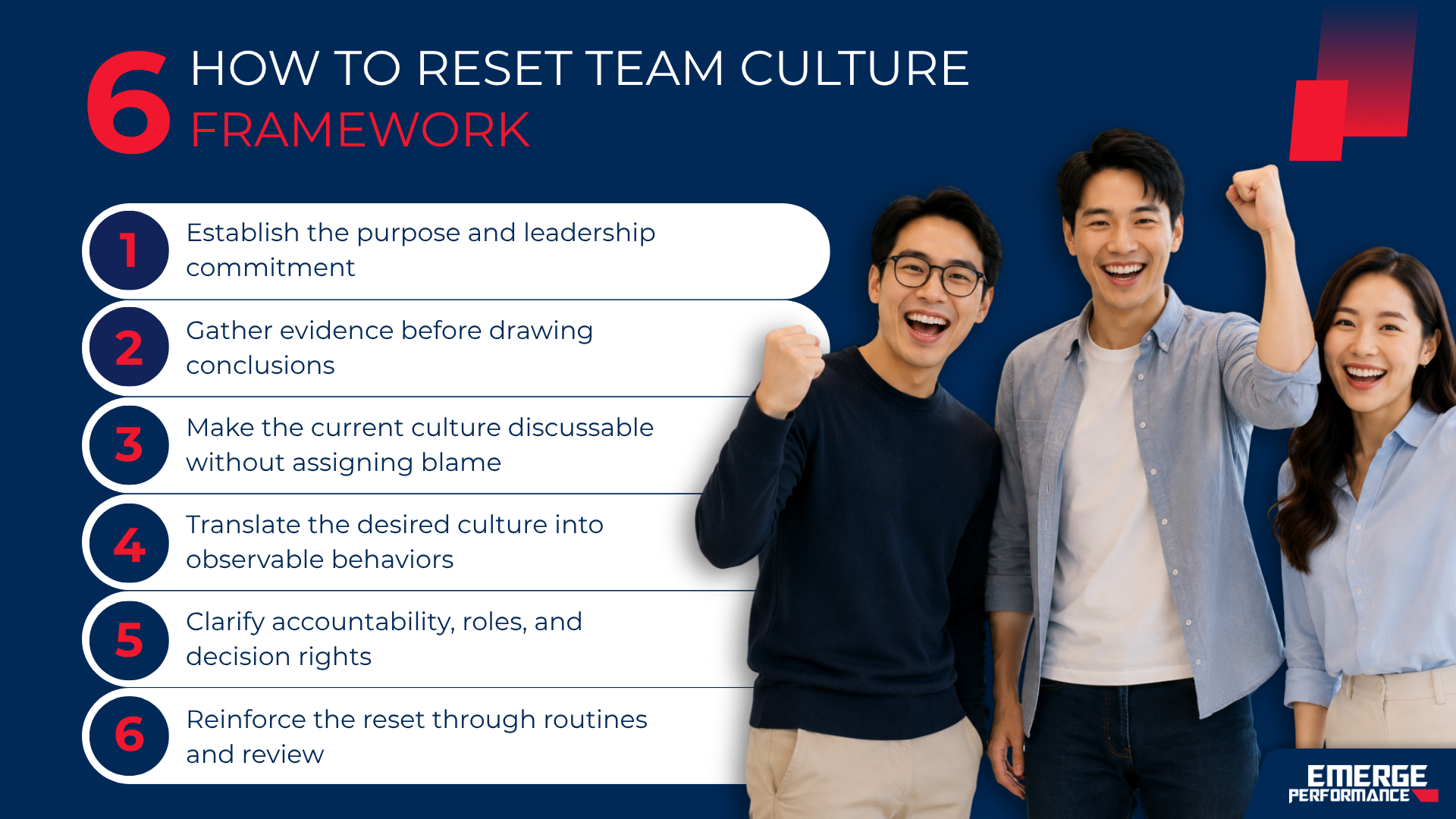
1. Establish the purpose and leadership commitment
Define why the reset is needed and what business or team outcome it should support. The leader and sponsor must be willing to hear difficult feedback and change their own behaviour. Without that commitment, the process risks becoming an exercise in asking employees to adapt to leadership problems.
2. Gather evidence before drawing conclusions
Use multiple sources: confidential interviews, a short pulse survey, team observations, exit themes, delivery data and examples from recent decisions. Look for repeated patterns rather than searching for proof of an existing assumption.
3. Make the current culture discussable without assigning blame
Share themes in neutral language: what the team does, when it happens, and what impact it creates. Separate intention from impact. The goal is collective ownership of the pattern, not consensus on who started it.
4. Translate the desired culture into observable behaviours
Choose three to five behaviours that matter most now. Replace vague commitments such as “communicate better” with concrete agreements: raise risks within 24 hours, clarify who decides before debate begins, challenge the idea without questioning the person, and close meetings with owners and deadlines.
5. Clarify accountability, roles and decision rights
Culture cannot compensate for structural ambiguity. Define who owns outcomes, who contributes, who decides, and how disagreements are escalated. Make dependencies visible so accountability does not become one-sided.
6. Reinforce the reset through routines and review
Integrate the agreements into meetings, onboarding, feedback, recognition and performance conversations. Review progress after 30, 60 and 90 days. Culture shifts when the new behaviour is repeatedly modelled, noticed and reinforced—especially under pressure.
A Sample 90-Minute Team Reset Conversation
A single session will not transform culture, but it can create a shared starting point. Use this agenda only when the team has enough safety to discuss its patterns openly. Where trust is very low, begin with confidential listening or external facilitation.
| Time | Focus | Facilitation question |
|---|---|---|
| 10 min | Set context and boundaries | Why are we having this conversation, and what would make it worthwhile? |
| 15 min | Review evidence and recent examples | What patterns do we notice in how we communicate, decide and follow through? |
| 20 min | Name what helps and hinders | What should we preserve? What is no longer serving our purpose? |
| 20 min | Define desired behaviours | What would we see and hear if we were working at our best? |
| 15 min | Agree working norms | Which three to five agreements will make the greatest difference? |
| 10 min | Commit and review | What will each of us do differently, and when will we assess progress? |
Facilitation principle: Move from observation to meaning to action. First describe what is happening, then explore its impact, and only then agree what to change. Jumping straight to solutions can leave the real pattern untouched.
How to Measure Whether the Reset Is Working
Culture is difficult to reduce to a single score. Use a small set of behavioural and performance indicators, and combine quantitative data with examples of how the team is working differently.
| Area | Leading indicators | Possible outcome indicators |
|---|---|---|
| Voice and safety | Risks raised earlier; broader participation; more constructive challenge | Fewer late surprises; improved learning and decision quality |
| Clarity | Clear owners, priorities and decision rights | Faster decisions; fewer duplicated or stalled tasks |
| Accountability | Commitments reviewed consistently; support requested earlier | Improved follow-through and delivery reliability |
| Collaboration | Earlier cross-functional involvement; direct conflict resolution | Reduced rework, escalation and silo delays |
| Sustainability | More realistic workload conversations; boundaries discussed | Lower regrettable turnover, absence or burnout risk over time |
Avoid over-interpreting short-term changes. A team may initially report more conflict because members are finally raising issues that were previously suppressed. Evaluate whether the conflict is becoming more direct, respectful and solvable—not whether disagreement has disappeared.
When Team Coaching or External Facilitation Can Help
Leaders can reset many team norms themselves. External support is more useful when the pattern is systemic, trust is low, the leader is part of the difficulty, or previous attempts have produced polite agreement without sustained change.
- The team needs a neutral space to surface issues that are difficult to raise internally.
- Conflict involves power differences or multiple stakeholder groups.
- The team understands the problem intellectually but repeatedly returns to the same behaviour under pressure.
- A new leadership team, merger, rapid scale-up or strategic shift requires a deliberate re-contracting of how the team works.
- The sponsor is prepared to support change in structures, incentives or leadership behaviour—not only team relationships.
Team coaching differs from simply facilitating a workshop. It works with the team as a system over time, helping members notice patterns, test new behaviours and connect the quality of their interactions with collective performance.
Frequently Asked Questions
How often should a team review its culture?
Teams do not need a full reset on a fixed schedule. A short quarterly health check can identify drift early, while a deeper reset is useful after major changes such as a new leader, restructuring, rapid growth, a merger, persistent delivery problems or repeated conflict.
How long does a team culture reset take?
The initial diagnosis and agreement may take several sessions, but behavioural change usually takes months of reinforcement. The more entrenched the pattern and the greater the power imbalance, the longer the work is likely to take.
Can a team culture reset fix toxic leadership?
Not by itself. If senior or team leadership continues to reward, tolerate or model harmful behaviour, a team workshop will not create lasting change. Leadership accountability must be part of the intervention.
Should HR lead the team culture reset?
HR or organisational development can design the process, provide data and facilitate. However, the team leader and sponsor must own the culture and model the agreed behaviours. Outsourcing ownership to HR weakens credibility.
How do you reset culture in a remote or hybrid team?
Make invisible norms explicit. Agree response-time expectations, meeting purposes, decision channels, documentation standards, inclusion practices and when synchronous conversation is necessary. Pay particular attention to who receives information informally and who may be excluded.
What if team members do not feel safe enough to speak openly?
Start with confidential interviews or an anonymous pulse, share themes without identifying individuals, and establish clear boundaries for the discussion. A neutral facilitator may be appropriate where the leader cannot credibly hold the process alone.
Key Takeaways
- Team culture usually drifts through repeated everyday behaviours before it becomes a visible crisis.
- Silence, low ownership, blame, inconsistent values and persistent tension are signals to investigate—not automatic proof of a culture problem.
- Leaders should distinguish team culture from individual performance, workload, process and wider organisational-system issues.
- A credible reset combines evidence, honest dialogue, observable behavioural agreements, clear accountability and sustained review.
- The leader must be willing to change. Culture work loses trust when employees are asked to adapt while leadership behaviour remains untouched.
Conclusion: Reset the Patterns, Not Just the Language
A healthy team culture is not one without pressure, disagreement or mistakes. It is one in which people can address those realities directly, learn from them and remain accountable to one another and the work.
The most useful question is not simply, “Do we have a good culture?” It is: “Are the ways we currently communicate, decide and work together helping us fulfil our purpose?” When the answer is no, a thoughtful reset can help the team preserve what is strong, release what no longer serves, and establish a more intentional way forward.
The Coaching Village
Free to join
Keep the culture conversation going.
Join a free learning community where coaches and leaders turn reflection into better practice—together.