Multinational team coaching is a structured process that helps a team improve how it works together across countries, cultures, time zones, and organizational boundaries. It is not about teaching people to behave according to a national stereotype. It is about helping the team notice the patterns that affect trust, participation, decisions, conflict, and delivery – then agree on better ways of working.
This matters because a global team can have capable people, a sound strategy, and strong individual intentions while still losing momentum in the handoffs between locations. Different assumptions about pace, hierarchy, disagreement, language, availability, and risk can remain invisible until they turn into delays or frustration. Team coaching gives the group a disciplined way to surface those assumptions and convert them into shared practice.
The International Coaching Federation (ICF) treats team coaching as a distinct professional discipline. Its Team Coaching Competencies build on the ICF Core Competencies and add specific expectations for working with the team as a whole, including agreements, trust, systemic awareness, collective learning, and ethical clarity.
What Is Multinational Team Coaching?
Multinational team coaching is team coaching applied to a team whose members work across more than one national, cultural, or regional context. The coach works with the team as the client while still recognizing the role of individual members, the team leader, sponsors, and the wider organization. The aim is not simply better meetings. It is stronger collective capability: clearer goals, healthier patterns of interaction, better decisions, and more reliable follow-through.
A useful starting point is to separate cultural difference from personal difference. Culture can shape expectations, but it does not predict what any one person will think or do. Team coaching therefore replaces assumptions with inquiry. Rather than deciding that one location is “too direct” or another is “too quiet,” the team explores what is happening, whose voice is missing, what conditions make participation easier, and which agreements will serve the work.
The ICF Team Coaching Competencies describe a practice that goes beyond applying individual coaching techniques in a group setting. The coach attends to the team as a system, helps the group recognize its own patterns, and supports collective action. This is particularly useful when complexity sits between members and locations rather than within one individual role.
Why Global Teams Need a Deliberate Operating Approach
Distance does not automatically create dysfunction. Many multinational teams perform exceptionally well. The challenge is that coordination costs can rise when people have fewer informal interactions, uneven access to information, different first languages, and limited overlap in working hours. Without explicit norms, the most vocal time zone, the most senior location, or the people with the easiest access to the leader can unintentionally dominate.
1. Communication can look clear while meaning differs
Words such as “urgent,” “aligned,” “committed,” or “we will try” may carry different practical meanings. A team coach helps members test interpretations through examples: What response time is expected? Who can make a decision? What does constructive challenge sound like here? The value comes from creating common working agreements, not from trying to eliminate difference.
2. Time zones make participation an equity issue
Repeatedly scheduling essential conversations at the convenience of one region sends a signal about whose contribution matters. A team can rotate inconvenient meeting times, use asynchronous decision preparation, and record clear outcomes. These are operational choices, but they also influence trust and willingness to speak candidly.
3. Conflict may become indirect or delayed
When relationships are mostly virtual, team members may avoid a difficult issue until it becomes a delivery problem. Coaching can help the group make disagreement discussable: name the issue, distinguish intent from impact, hear multiple perspectives, and agree on what must change in the work rather than assigning blame.
4. The team may optimize locally instead of collectively
Regional targets, customer needs, and reporting lines can create sensible local priorities that still compete at the enterprise level. Systemic team coaching makes those tensions visible and asks the group to define the few outcomes that require joint ownership.
Team Coaching vs. Facilitation, Consulting, and Team Building
These approaches can complement each other, but they are not interchangeable. A clear distinction protects the team from buying the wrong intervention for the problem.
A multinational team may need more than one of these. For example, it may use facilitation to make a strategic decision, consulting to redesign a process, and team coaching to change how it collaborates over time. The important question is not which label sounds most attractive; it is what the team needs to be able to do differently after the intervention.
Five Conditions to Check Before Starting Team Coaching
- A meaningful shared purpose: the team can name work that requires collective effort, not just a set of individual tasks.
- A real team boundary: members, core roles, and the relationship to sponsors or stakeholders are sufficiently clear.
- Sponsor alignment: the leader and relevant stakeholders understand the purpose, scope, confidentiality boundaries, and measures of progress.
- Enough contact to practice: the team has recurring moments where it can test new agreements and reflect on them.
- Readiness for candor: there is willingness to examine the team system, including leadership patterns and organizational constraints, rather than treating one person as the problem.
If these conditions are absent, coaching may still be useful, but the first work may be contracting, role clarification, or an operating-design conversation. Starting with a diagnostic label before creating agreement can make people defensive and reduce the chance of honest learning.
A Six-Step Framework for Multinational Team Coaching
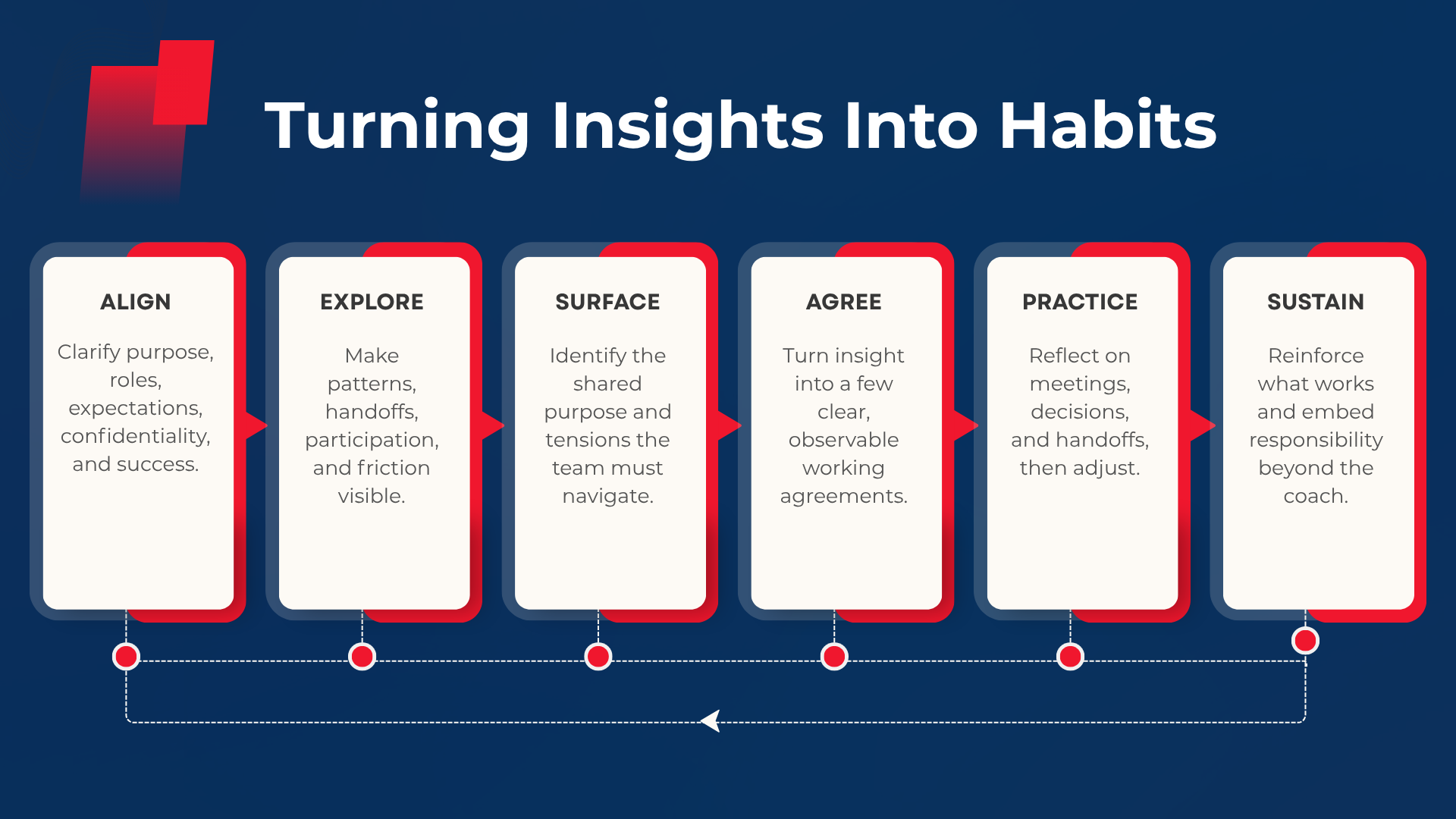
Step 1: Contract with the whole system
Clarify who the client is, who sponsors the work, what information may be shared, how confidentiality works, and what success would look like. Include the team leader, members, and relevant stakeholders where appropriate. ICF guidance emphasizes clear agreements with all relevant parties; in a multinational setting, this prevents different locations from receiving different messages about the work.
Step 2: Build a shared picture of the current reality
Use interviews, observation, team reflection, or a short survey to understand the team’s work and interaction patterns. Look for evidence: missed handoffs, repeated decisions, uneven participation, customer impact, or stalled priorities. Avoid treating a cultural explanation as the answer before the team has examined its own experience.
Step 3: Name the collective purpose and key tensions
Ask the team to describe what it must achieve together and what makes that difficult. Productive tensions might include global consistency versus local responsiveness, speed versus inclusion, or autonomy versus alignment. A team often gains traction when it can hold both sides of a tension rather than declaring one side correct.
Step 4: Create working agreements that fit the work
Turn insight into observable practices. Agreements can cover meeting rotation, decision rights, response times, documentation, challenge, escalation, language inclusion, and how the team will revisit a decision. Keep the list short enough to use. The test is whether a new colleague could see the agreement in action, not whether it sounds thoughtful on a slide.
Step 5: Practice reflection in real work
Use short after-action reviews after important meetings, launches, or handoffs. Ask what helped, what limited the team, whose perspective was absent, and what to change next time. This creates a learning rhythm without turning every meeting into a coaching session.
Step 6: Review the system and sustain ownership
Periodically return to the original purpose and measures. Notice what has changed in the team’s behavior and results. Decide which habits the team will own without the coach, what the leader must reinforce, and which organizational barriers require sponsor action.
Questions That Surface Useful Differences
Good questions invite people to describe their experience rather than defend a position. Choose questions that are relevant to the work, and balance inquiry with the direct feedback or decision-making the situation requires.
- What does a successful outcome require from us collectively that no location can deliver alone?
- Where do we lose time or clarity at the handoffs between our locations?
- Whose perspective is easiest to miss in our current way of working?
- What does respectful challenge look and sound like on this team?
- Which decision rights are clear, and which are being renegotiated in meetings?
- What are we assuming about another location that we have not checked?
- What would make participation more equitable across time zones and languages?
- What is one agreement we can test in the next two weeks?
How to Measure Progress Without Over-Measuring
Measure both the work and the way the team works. A coaching engagement is not successful simply because participants enjoyed the sessions, nor should every human interaction be converted into a dashboard. Choose a small set of indicators that reflect the team’s purpose and revisit them consistently.
What the ICF ACTC Means for Team Coaches
The ICF Advanced Certification in Team Coaching (ACTC) is a professional certification for ICF credential-holders who specialize in team coaching. It is not a guarantee that a particular engagement will succeed, and it does not replace organizational expertise. It does, however, signal that the coach has met ICF’s current requirements for specialized team coaching education, experience, supervision, and assessment.
ICF lists three application paths. Its general education path requires an active ICF credential in good standing, at least 60 hours of team coaching education, five team coaching engagements within the previous five years, five hours of coaching supervision, and a passing score on the ICF Team Coaching Certification Exam. An ICF Advanced Accredited Team Coaching program and a prior-learning path have different documentation requirements. Because credential rules can change, prospective applicants should check the current ICF ACTC page and candidate guide before planning their application.
For organizations selecting a team coach, ACTC can be one useful signal. It should sit alongside a conversation about the coach’s relevant experience, approach to contracting, ethical boundaries, understanding of the business context, and ability to work across the languages and locations involved.
A 90-Day Starting Plan for Leaders and HR
Days 1-30: Clarify the challenge and contract
- Identify the business outcomes that require better collaboration across locations.
- Map core team members, sponsors, stakeholders, and existing interventions.
- Agree the scope, confidentiality boundaries, and a small set of progress measures.
- Gather examples of the team’s current coordination and decision-making patterns.
Days 31-60: Make patterns visible and test agreements
- Hold a team session to define purpose, tensions, and the few habits that matter most.
- Test practical agreements on meeting rotation, decision rights, documentation, and escalation.
- Build short reflection moments into real operating meetings.
- Ask members whether the process is enabling candor, clarity, and follow-through.
Days 61-90: Review evidence and embed ownership
- Review delivery and interaction evidence with the team and sponsors.
- Refine agreements that are too vague, too heavy, or not being used.
- Decide what the leader will reinforce and what the team will self-manage.
- Set the next review point so new habits are sustained beyond the initial intervention.
Common Mistakes to Avoid
- Treating culture as a label rather than a source of hypotheses to test with the team.
- Using one workshop as a substitute for changing day-to-day operating habits.
- Inviting openness without clarifying confidentiality, decision rights, or sponsor expectations.
- Overloading the team with norms that are too numerous to remember or practice.
- Assuming virtual participation is equal because everyone has a meeting link.
- Ignoring the team leader’s role in reinforcing agreements and modeling the desired behavior.
- Confusing coaching with avoiding difficult feedback, clear direction, or accountability.
Frequently Asked Questions
What is the difference between team coaching and group coaching?
Group coaching typically supports several individuals around their own goals. Team coaching works with an interdependent team on its shared purpose, relationships, and collective performance. The distinction matters because the contracting, confidentiality, and measures of progress are different.
Can multinational team coaching be done virtually?
Yes. Virtual delivery can work well when the engagement deliberately addresses technology, meeting design, language inclusion, asynchronous work, and time-zone equity. Some teams also benefit from occasional in-person work, but physical co-location is not the only route to meaningful team learning.
How long does a team coaching engagement take?
There is no universal duration. A focused intervention may begin with several months of contracting, observation, team sessions, and between-session practice. The right cadence depends on the team’s work cycle, urgency, maturity, and the scale of change required.
Does an ACTC-certified coach only work with multinational teams?
No. ACTC recognizes specialized team coaching capability, not one type of team. A multinational engagement may also require experience with virtual collaboration, language diversity, regional stakeholders, and the relevant business context.
Should the team leader be in every coaching session?
Usually the leader is part of the team and should participate, but the engagement design may also include sponsor conversations, individual interviews, or sessions with different stakeholders. The key is to agree roles and confidentiality before the work starts.
How do the eight ICF core competencies relate to team coaching?
ICF’s current core coaching model has eight overarching competencies: Demonstrates Ethical Practice, Embodies a Coaching Mindset, Establishes and Maintains Agreements, Cultivates Trust and Safety, Maintains Presence, Listens Actively, Evokes Awareness, and Facilitates Client Growth. Team coaching builds on that foundation while applying the competencies to the team as a collective system. For ACTC practice, the ICF Team Coaching Competencies add team-specific attention to areas such as multi-party agreements, the team’s patterns and culture, collective trust and safety, and turning shared awareness into collective action.
How Can Multinational Teams Create Strategic Alignment?
Start by defining the one or two outcomes that require joint ownership across locations. Then make the operating choices explicit: decision rights, success measures, handoffs, escalation paths, and the trade-offs between global consistency and local responsiveness. Review those agreements in real work, not only in workshops. Strategic alignment is visible when people can explain the shared priority, understand what they own, and resolve a cross-border tension without waiting for the next leadership meeting.
Key Takeaways
- Multinational team coaching helps interdependent teams improve how they work across locations, cultures, time zones, and organizational boundaries.
- The work should replace assumptions with inquiry and turn insight into a few observable operating agreements.
- Team coaching complements facilitation, consulting, training, and team building; it does not replace them.
- The ICF ACTC is a specialized professional certification built on the ICF Team Coaching Competencies and current eligibility requirements.
- Leaders get the best results by contracting clearly, practicing in real work, measuring a few meaningful signals, and sustaining ownership.
Conclusion: Build the Team System, Not Just Individual Capability
The power of multinational team coaching lies in making the invisible parts of collaboration available for discussion. When a team can name how it decides, challenges, learns, and shares responsibility across borders, it is better able to use diversity as a source of insight rather than a source of friction.
The practical starting point is modest: choose one shared outcome, notice one recurring coordination pattern, and test one agreement that makes collaboration clearer or more equitable. Over time, those small experiments can build the team’s ability to adapt together – which is the capability global work demands most.
References
- International Coaching Federation. ICF Team Coaching Competencies.
- International Coaching Federation. Advanced Certification in Team Coaching (ACTC).
- International Coaching Federation. ACTC Candidate Guide.
- Henderson, L. S., Stackman, R. W., and Lindekilde, R. Why cultural intelligence matters on global project teams. International Journal of Project Management, 2018.
- International Coaching Federation. 2025 ICF Core Competencies.