What Is Organizational Agility?
Organizational agility is an organization’s ability to notice meaningful changes in its environment, make choices, and adapt its work in a coordinated way. It combines strategic clarity with operational learning. Agile organizations do not treat every signal as a reason to reorganize. They distinguish between a temporary disruption and evidence that priorities, processes, capabilities, or customer assumptions need to change.
The Agile Manifesto was written for software development, so it should not be copied mechanically into every function. Its underlying themes remain useful more broadly: value people and interactions, collaborate closely with customers or stakeholders, deliver in smaller increments, and respond to change when evidence justifies it. In an OD context, those themes become practical questions about participation, feedback, experimentation, and learning.
Agility is therefore not a personality trait or a slogan. It is a set of organizational habits: clear choices, short learning cycles, candid information flow, disciplined follow-through, and the willingness to revise an approach when the evidence says it is not working.
Why Change Efforts Lose Momentum
The popular statement that “70% of change fails” is too blunt to be a useful planning tool. Different studies define success, scope, and failure differently. A better question is: which parts of the change are not being adopted, by whom, and why? That moves the conversation from a dramatic statistic to observable evidence.
1. The case for change stays abstract
Employees may understand a strategic announcement while still not know what will change in their own decisions, workload, relationships, or performance expectations. When the “why” is not connected to real work, people fill the gaps with assumptions or wait for the initiative to pass.
2. Design happens without enough frontline insight
Senior leaders often hold an essential enterprise view, while frontline people understand the operational constraints that determine whether a solution will work. Co-creation does not mean asking everyone to approve every decision. It means involving people early enough to improve the design, anticipate consequences, and create credible local ownership.
3. The organization changes too many things at once
When several initiatives compete for the same attention, managers can become translators for overlapping messages rather than leaders of adoption. A portfolio view helps leaders sequence work, stop lower-value activity, and make the few non-negotiable changes visible.
4. Learning arrives after the launch
A post-implementation review can be valuable, but it is too late to correct the obstacles that people encounter in the first weeks. Short feedback loops allow teams to test assumptions, identify friction, and adapt training, systems, or communication while adoption is still forming.
5. The formal system rewards old behavior
People notice what is measured, promoted, funded, and modeled. If leaders ask for collaboration but reward local optimization, the old operating system will win. OD makes these contradictions discussable and helps align structures, incentives, and everyday leadership behavior with the desired change.
Agility, Organizational Development, and Change Management
These disciplines overlap, but each makes a distinct contribution. Strong transformations usually combine them instead of asking one approach to do all the work.
For example, a new customer platform needs project management to deliver the technology, change management to support adoption, OD to address the leadership and workflow implications, and agility to keep the implementation responsive to customer and employee feedback. Treating any one of these as optional can create a gap between a technically complete rollout and a change that people actually use.
Five Practices That Make Change Stick
1. Make the change concrete at the point of work
Translate the change into practical moments: a manager’s next team meeting, a customer handoff, a decision made differently, or a process no longer required. Give people examples of what to start, stop, continue, and escalate. A clear message is useful; a clear operating expectation is what allows people to act.
2. Co-create where local knowledge improves the answer
Use pilots, listening sessions, design groups, and manager forums to test the parts of the solution that affect real work. Be explicit about what is fixed and what is open to influence. This avoids false participation while still using the knowledge closest to the customer, process, or team.
3. Build short learning loops into the implementation
Set a regular rhythm to ask: What is working? Where is the friction? What evidence do we have? What will we adjust? A learning loop should produce a decision or experiment, not another survey with no visible consequence. Publish what the organization heard and what changed as a result.
4. Protect capacity for the new way of working
Adoption needs time. Managers need room to explain the change, employees need practice, and teams need space to surface problems. When a change adds work without removing or simplifying something else, it is likely to be treated as a temporary extra rather than the new normal.
5. Reinforce the behavior through the system
Align measures, decision rights, routines, performance conversations, and recognition with the desired behavior. This is where change moves from a communication campaign to an operating system. Leaders should be able to point to the mechanisms that now make the new way easier than the old one.
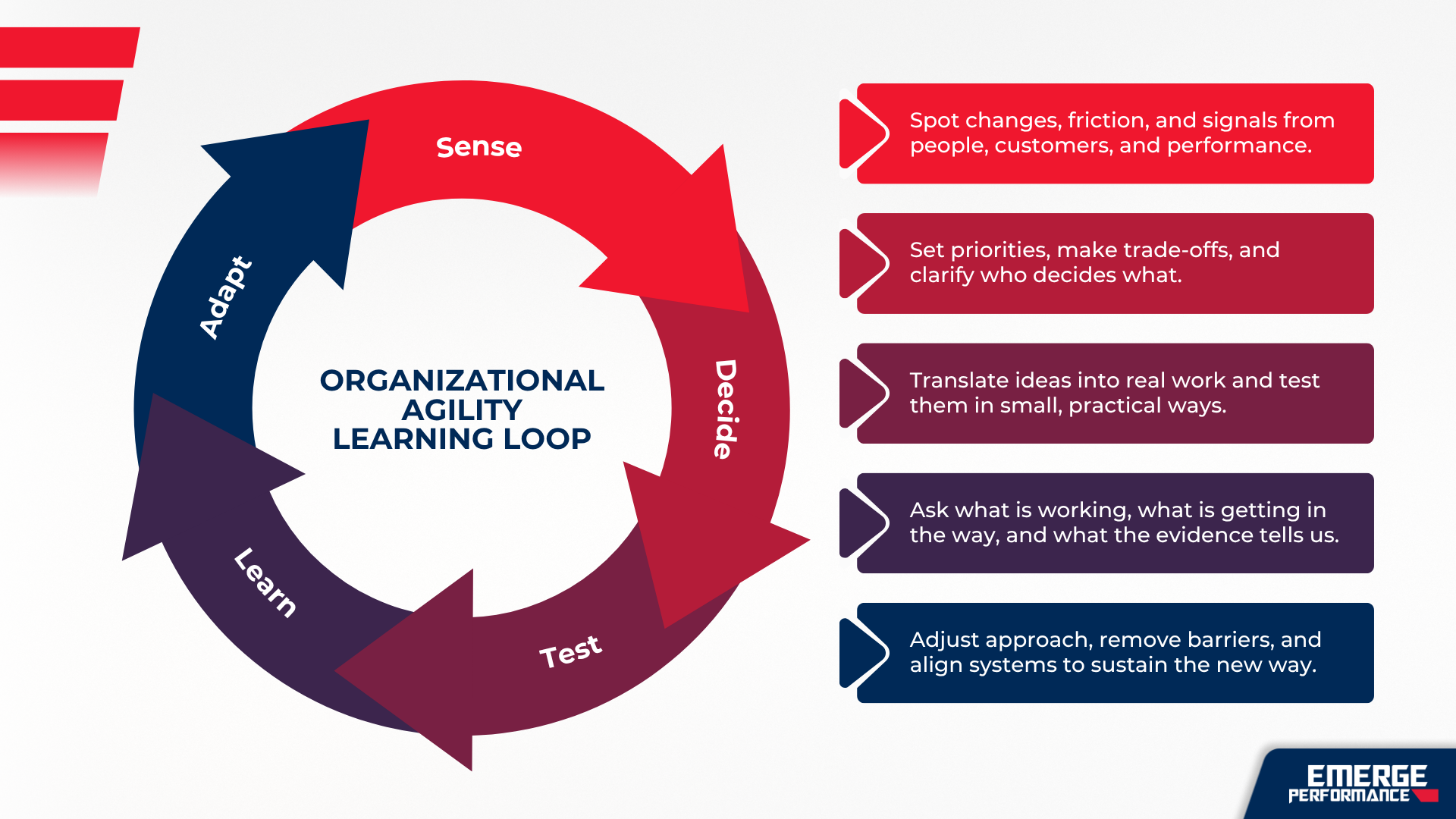
How to Create Strategic Alignment During Change
Strategic alignment is not achieved by asking everyone to agree with every decision. It is achieved when people can explain the shared outcome, understand the priorities and trade-offs, know who decides, and see how their work contributes. The task is to create enough clarity for coordinated action while keeping enough feedback open for learning.
- Name the outcome, not just the activity: define the customer, business, or capability result the change must produce.
- Choose the few priorities that matter now: explain what will not be pursued or will be sequenced later.
- Clarify decision rights and escalation: people should know who decides, who contributes, and how conflicts are resolved.
- Create shared measures: combine outcome measures with adoption and capability signals so progress is not confused with activity.
- Repeat the conversation in local contexts: managers should connect enterprise intent to the practical choices their teams face.
Alignment is tested by behavior. If teams must repeatedly ask for permission on routine decisions, if different functions are optimizing incompatible measures, or if managers tell different stories about the purpose, then the organization has a clarity problem to solve – not a communications problem to decorate.
How Leaders Can Support Adoption
Leaders are not only sponsors who announce a change. They are interpreters, role models, and removers of barriers. Prosci’s benchmarking research reports a strong association between effective sponsorship and meeting change objectives; use that evidence as a prompt to define what visible sponsorship means in your context rather than as a substitute for a plan.
- Explain the purpose consistently, including what is known, uncertain, and still being tested.
- Model the behavior the change requires, especially when it is inconvenient or involves a real trade-off.
- Ask managers what they need to lead the change rather than assuming a slide deck is enough.
- Make it safe to report a problem, a failed experiment, or an unintended consequence early.
- Remove a barrier or obsolete requirement when teams show that it prevents adoption.
- Recognize learning and responsible adaptation, not only visible compliance.
Psychological safety is relevant here because learning depends on people being willing to speak up about risks, mistakes, and questions. It does not mean lowering standards or avoiding accountability. It means creating the interpersonal conditions in which teams can surface the information needed to improve the work.
What to Measure During an Agile Change
Measure what helps the organization make a better next decision. Avoid dashboards that track only activity, such as the number of communications sent or people trained. Those inputs can matter, but they do not show whether the new behavior is being used or whether it is producing the intended result.
A 90-Day Starting Plan
Days 1-30: Diagnose and focus
- Define the outcome and the few behaviors that matter most.
- Map stakeholder groups, operational impacts, constraints, and existing initiatives.
- Identify what can be piloted, what is non-negotiable, and what needs a decision.
- Create a small baseline of outcome, adoption, capability, and experience measures.
Days 31-60: Pilot, listen, and adapt
- Run a focused pilot with real work, clear support, and a visible sponsor.
- Give managers practical talking points, examples, and an escalation route.
- Collect feedback through short conversations and observation, not only large surveys.
- Adapt the solution, training, workflow, or communication based on evidence.
Days 61-90: Reinforce and scale carefully
- Review the pilot against the intended outcome and the adoption evidence.
- Remove unnecessary work, clarify roles, and make the new routines easier to repeat.
- Share what was learned, including what changed because of feedback.
- Scale in waves only when the support model and enabling systems are ready.
Common Mistakes to Avoid
- Calling every fast project “agile” without creating learning or feedback loops.
- Using a dramatic failure statistic in place of a diagnosis of the current situation.
- Treating resistance as a personality problem instead of checking clarity, capacity, trust, and consequences.
- Running participation sessions after the key design decisions are already fixed.
- Launching training before people understand the practical change to their work.
- Adding a new process without retiring outdated steps, reports, or approval layers.
- Measuring communication activity while ignoring adoption and customer impact.
Frequently Asked Questions
Is organizational agility the same as Agile?
No. Agile commonly refers to principles and methods that originated in software development. Organizational agility is broader: it describes how the organization senses, decides, learns, and adapts across strategy, operations, people, and customer needs. Agile ways of working can contribute to organizational agility, but they are not the whole of it.
How do you make organizational change stick?
Make the desired behavior concrete, involve people where their knowledge improves the design, build short learning loops, protect capacity for adoption, and reinforce the change through measures, routines, leadership behavior, and systems. Check adoption in real work rather than assuming a launch equals success.
What is the role of organizational development in change management?
OD addresses the conditions that enable sustained change: culture, relationships, leadership, systems, structures, and capability. Change management focuses more specifically on helping affected people adopt and use a change. The two are complementary.
How can leaders create strategic alignment?
Leaders create alignment by stating the shared outcome, narrowing priorities, clarifying decision rights and trade-offs, connecting the strategy to local work, and using shared evidence to revise the approach. Alignment is visible in coordinated decisions and follow-through, not in universal agreement.
Does psychological safety make change slower?
Not necessarily. Psychological safety can help teams surface concerns and learning earlier, which reduces the cost of discovering problems late. It should sit alongside clear standards, decision making, and accountability; it is not an alternative to them.
Key Takeaways
- Organizational agility is disciplined adaptation, not constant speed or reorganization.
- Change sticks when people can connect the purpose to their work, practice the new behavior, and see it reinforced by the system.
- OD, change management, project management, and agility make complementary contributions to successful transformation.
- Strategic alignment requires shared outcomes, clear choices, decision rights, and practical feedback loops.
- A focused pilot and a small set of meaningful measures are more useful than a large launch with no learning cycle.
Conclusion: Make Learning Part of the Operating System
Lasting change is not created by a perfect plan or an inspiring launch. It is created when an organization can keep noticing what people and customers are experiencing, make decisions based on that evidence, and reinforce the behaviors that produce better results.
That is the practical promise of agility in action. It gives organizations a way to hold strategic intent and human adaptation together: clear enough to coordinate, flexible enough to learn, and disciplined enough to make the new way of working stick.
References
- Manifesto for Agile Software Development. https://agilemanifesto.org/
- Principles behind the Agile Manifesto. https://agilemanifesto.org/principles
- Edmondson, A. Psychological Safety and Learning Behavior in Work Teams. Administrative Science Quarterly, 1999. https://web.mit.edu/curhan/www/docs/Articles/15341_Readings/Organizational_Learning_and_Change/Edmondson_1999_Psychological_safety.pdf
- Best Practices in Change Management. https://www.prosci.com/blog/change-management-best-practices
- The Correlation Between Change Management and Project Success. https://www.prosci.com/blog/the-correlation-between-change-management-and-project-success